

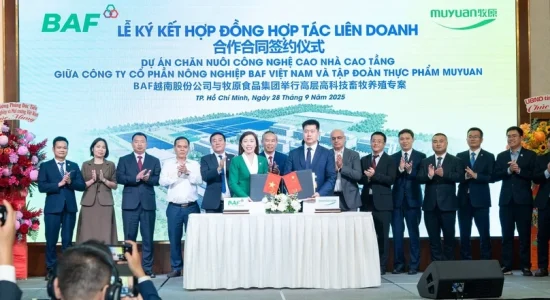
BAF Vietnam Agriculture JSC has partnered with China’s Muyuan Foods to build a USD 454 million high-rise pig farming complex in Tay Ninh province. Announced on September 28, the venture will house 64,000 sows and produce 1.6 million pigs annually.
A feed plant with 600,000 tons capacity will support operations, with expected annual revenue reaching USD 378.5 million.
Efficiency gains through high-rise design
The high-rise model, already proven in China, maximizes land use efficiency by five to eight times compared to traditional farms. It also reduces labor needs by 20–30%, offering solutions for regions facing limited farmland and rising costs.
Each floor will operate independently to prevent cross-infection, supported by air filtration, precision ventilation, and sterilization systems with 99.9% effectiveness. Intelligent robots will monitor pig health, while AI-driven cough detectors will diagnose illness early, ensuring biosecurity and animal welfare.
Strategic expansion and industry impact
BAF CEO Bui Huong Giang emphasized that the project will modernize Vietnam’s livestock sector, ensuring clean, safe, and competitively priced pork. The company aims to expand to 450,000 sows and 10 million pigs by 2030, aligning with Vietnam’s transition from small-scale farming to industrialized production.
Muyuan, the world’s largest pig farming enterprise, brings extensive expertise. In 2024, it supplied 71.6 million pigs and slaughtered 12.52 million, supported by 20 advanced technologies and 2500 patents. Its proven track record strengthens confidence in the Tay Ninh venture.
Responding to sector challenges
Vietnam’s livestock industry has faced challenges from disease outbreaks and rising costs. This project represents a strategic response, combining international cooperation, government support, and technological innovation to stabilize supply and enhance competitiveness. Tay Ninh authorities have welcomed the investment, seeing it as part of Vietnam’s broader push toward industrial-scale farming.
The complex will also include waste treatment systems designed to reduce emissions and protect surrounding communities, reinforcing its role as a model for sustainable agriculture. Beyond production, the venture is expected to create jobs in Tay Ninh and stimulate related industries such as feed supply, veterinary services, and logistics. Technology transfer from Muyuan will provide local staff with advanced training, strengthening Vietnam’s expertise in modern livestock management.
By integrating advanced systems, scaling production, and reducing reliance on pork imports, the joint venture positions Vietnam as a regional leader in high-tech agriculture while meeting rising consumer demand.