


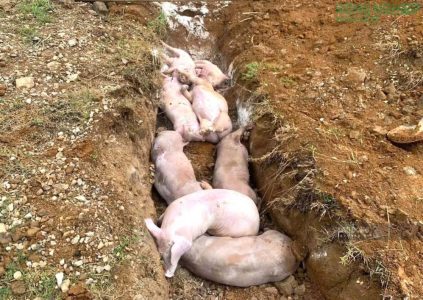
Nghe An, a province in north central Vietnam, has stepped up efforts to contain African swine fever (ASF) after the province recorded more than 30 outbreaks and culled about 7500 pigs this year. Provincial authorities have issued an urgent directive as disease risks remain elevated in parts of the province.
Media reports said the ASF situation has improved compared with the same period in 2025. However, officials warned that the disease remains complex in some localities. Flooding, along with increased transportation, slaughter, and consumption of pigs and pork products, continues to raise the risk of disease spread.
Directive targets weaknesses in disease prevention
The People’s Committee of Nghe An Province issued Official Dispatch No. 27/CD-UBND on October 16, directing agencies and local authorities to strengthen ASF prevention and control activities. Officials said several shortcomings continue to undermine disease-control efforts in some areas.
Authorities cited delays in outbreak detection and response, insufficient personnel and funding, and shortcomings in sanitation and disinfection. They also identified inadequate management of livestock farming, collection, transportation, and slaughter activities. Communication and guidance for livestock producers remain limited in some localities.
To address these issues, local governments have been instructed to strengthen coordination with veterinary services and ensure resources are available when outbreaks occur. These include personnel, chemicals, equipment, disposal sites, and funding.
Local governments face direct responsibility
The directive places direct responsibility on commune- and ward-level authorities for disease prevention and control within their jurisdictions. Officials have also been instructed to strengthen animal disease prevention committees and clearly assign responsibilities for specific areas and tasks.
Provincial leaders warned that local officials could be held accountable if negligence allows ASF or other dangerous livestock diseases to spread widely. Authorities said failures in leadership and supervision could result in significant damage within their managed areas.
For outbreak areas, local governments must identify infection sources and implement disease-control measures in affected, threatened, and buffer zones. High-risk transportation routes may also face stricter controls when necessary.
Outbreaks continue to weigh on producers
According to provincial statistics, ASF outbreaks this year have resulted in the destruction of about 7,500 pigs with a combined weight of approximately 450 tons. Although the situation has improved from 2025 levels, authorities said several localities continue to face disease challenges.
Localities reporting significant pig losses include Chau Tien, Quy Chau, Nga My, Tuong Durong, Nghia Dong, and Luong Minh. In Anh Son Commune, outbreaks detected in early October led authorities to cull more than 6.5 tons of infected pigs.
According to specialized agencies, seasonal weather changes, prolonged rainfall, and flooding have increased disease risks. Small-scale and free-range livestock production in some areas has also complicated prevention efforts. Authorities further warned that restocking without adequate safety conditions could lead to disease recurrence.
Stricter controls focus on biosecurity and compliance
Authorities have ordered sanitation, disinfection, and sterilization at affected facilities, disposal areas, collection points, slaughterhouses, markets, and transportation vehicles. They have also called for the proper disposal of infected pigs and pig products to prevent further spread.
The province is strengthening enforcement against activities that increase disease risks. The directive calls for stricter control of pig transportation, trading, and slaughter, while targeting outbreak concealment, the sale of sick pigs, and the disposal of carcasses into the environment.
Officials also emphasized that ASF does not spread to humans. However, infected pigs, dead pigs, and products subject to disposal are prohibited from entering the food chain.
The province is continuing its Autumn 2026 vaccination campaign, with communes and wards instructed to achieve vaccination coverage exceeding 80% of the total herd.
Support available for affected farmers
Alongside disease-control efforts, Nghệ An is continuing support programs for affected producers. Under current provincial regulations, eligible farmers whose pigs are culled because of disease can receive support of VND40,000/kg (approximately USD 1.54/kg) live weight. Authorities have directed local governments to complete support dossiers promptly to help livestock producers reduce losses.
For areas where outbreaks have ended, restocking must be carried out carefully. Producers must ensure proper barn hygiene, use breeding stock of clear origin, and comply with veterinary guidance before reintroducing animals.
As ASF continues to affect parts of the province, authorities are focusing on tighter outbreak management, improved biosecurity, and timely support for affected producers.