



Vietnam’s meat industry recorded encouraging gains in export value and international market expansion during Q1 2026, even as shipment volumes fell.
Export performance in Q1
Data from the Vietnam Customs Department showed divergence between volume and value. Export volume reached 4,600 tons, down 13.7% year‑on‑year.
Export value rose 11.3% to USD 33.32 million, with shipments sent to 21 countries and territories.
This contrast highlights exporters’ growing focus on higher value‑added products and benefits from stronger global meat prices, which offset declining shipment volumes.
Market developments and destinations
Hong Kong remained the largest market, accounting for more than half of total export value. Shipments dropped 36.2% year‑on‑year, mainly suckling pork and frozen pigs.
Several traditional markets, including Canada, Malaysia, South Korea, and the Netherlands, also recorded downturns, reflecting weaker demand and competitive pressures.
By contrast, exports to China, France, Singapore, Japan, the US, and Cambodia grew. This expansion underscores Vietnam’s push to diversify and reduce reliance on traditional partners.
Penetration into demanding markets signals improved competitiveness and stronger alignment with international standards, supporting long‑term industry growth.
Export product structure
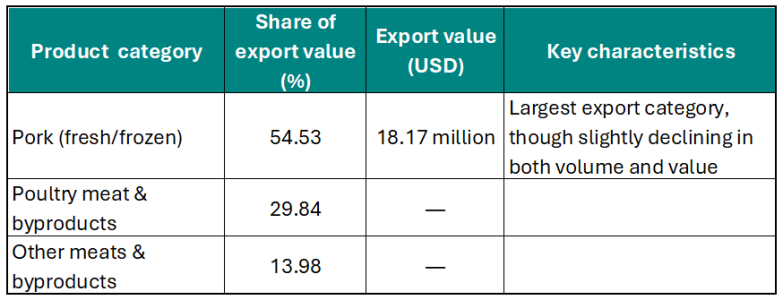
Pork remained the largest export category, contributing 54.53% of total export value, or USD 18.17 million. Both volume and value declined slightly.
Poultry meat and by‑products accounted for 29.84% of export value, securing the second‑largest share. Other meats and by‑products contributed 13.98%, adding diversity to the portfolio.
This structure reflects Vietnam’s reliance on pork exports while gradually expanding into poultry and other categories to balance risks.

Industry outlook and trends
Despite global economic uncertainties, two clear trends are shaping Vietnam’s meat industry.
Exporters are prioritizing product quality and value‑added processing to sustain revenue growth despite declining shipment volumes.
At the same time, diversification into demanding markets such as the US, France, and Japan is expected to strengthen long‑term sustainability and reduce risks from overreliance.