


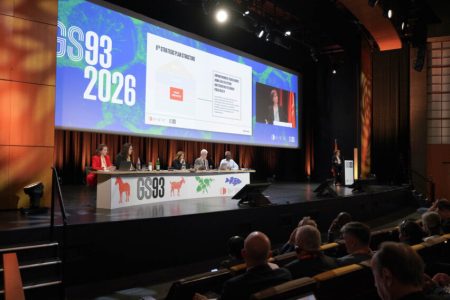
The adoption of the WOAH 8th Strategic Plan on 20 May 2026 marks a pivotal moment for global animal health, as Members of the World Organisation for Animal Health (WOAH) endorse a unified roadmap for the period 2027–2031.
Agreed during the General Session following months of consultation, the WOAH 8th Strategic Plan comes at a time of mounting pressure on animal health systems worldwide. Its adoption signals a collective commitment by our Members to strengthen prevention, invest in resilience and position animal health as a cornerstone of global stability.
The urgency of this agenda is underscored by the latest State of the World’s Animal Health report, released on 13 May 2026, which highlights accelerating disease risks, widening investment gaps and growing strain on veterinary systems. The report shows that more than 20% of global animal production is lost to preventable diseases each year, while less than USD 1 billion annually is invested in animal health systems.
Responding to a rapidly evolving global context
Against this backdrop, the WOAH 8th Strategic Plan sets out a clear vision: to strengthen animal health systems as a foundation for food security, public health, economic resilience and sustainable development.
Animal health challenges are becoming more complex and interconnected. Climate change is altering disease patterns, global trade is increasing the speed of spread, and antimicrobial resistance continues to threaten treatment effectiveness. At the same time, demand for animal-source food is rising, placing additional pressure on already fragile systems.
The Strategic Plan therefore positions animal health not as a technical issue, but as a strategic global priority that requires coordinated action across countries and sectors.
At its core, the WOAH 8th Strategic Plan is structured around three strategic orientations, each designed to address critical gaps identified through Member consultations and global evidence.
1. Strengthening global standards for a changing world
WOAH’s first priority is to continue developing international standards for animal health and welfare, ensuring they remain scientifically robust, adaptable and applicable to all Members.
These standards underpin safe trade, guide national policies and support the development of effective animal health systems. However, their impact depends on both their relevance and their implementation. The Plan therefore emphasizes greater Member involvement in the standard-setting process, alongside efforts to better understand and address barriers to adoption.
By reinforcing its scientific base and ensuring standards evolve with emerging risks—such as new diseases, technological advances and shifting production systems—WOAH aims to strengthen trust, transparency and consistency across global animal health governance.
2. Empowering national animal health systems
The second strategic priority focuses on strengthening animal health and welfare systems, which form the backbone of disease prevention, detection and response.
While progress has been made, significant gaps remain in workforce capacity, surveillance systems and emergency preparedness. These gaps increase the likelihood that outbreaks will spread and escalate, with consequences for food systems, livelihoods and public health.
The Plan responds by prioritizing capacity-building, knowledge sharing and stronger collaboration between Members. It adopts a holistic One Health approach, recognizing the interdependence of animal, human and environmental health.
By equipping countries with the tools, expertise and resources needed to build resilient systems, WOAH aims to shift from reactive crisis management to proactive prevention—an approach that is both more effective and significantly less costly in the long term.
3. Elevating animal health as a global priority
The third strategic orientation aims to position animal health at the centre of global policy discussions and investment decisions.
Recognizing animal health’s critical importance, the Plan seeks to ensure that animal health is prioritized in national and international agendas. The State of the World’s Animal Health report makes clear that this underinvestment carries significant risks, from food insecurity and economic losses to the growing threat of zoonotic diseases and pandemics.
The Plan therefore places a strong emphasis on advocacy, communication and engagement with decision-makers and segments of the wider public. By strengthening its role in global forums and supporting Members in their national advocacy efforts, WOAH aims to mobilize greater political will and financial investment as well as fostering more broadly an understanding about the importance of animal health in a One Health context.
The objective is clear: to ensure that animal health is recognized not as a niche concern, but as a global public good essential to health security, economic stability and sustainable development.
From adoption to implementation
While the WOAH 8th Strategic Plan will formally take effect in 2027, its adoption in May 2026 marks the beginning of a critical transition phase. The Plan outlines a structured approach to implementation, supported by organisational enablers. Global and regional roadmaps, coupled with robust monitoring frameworks, will ensure transparency and effective strategic management of its implementation.
Sustained engagement and investment from Members and partners will be a major driver of success of the Plan. The adoption of the WOAH 8th Strategic Plan reflects a shared recognition: in a world of increasing disease risk and constrained resources, prevention is not optional – it is essential.
By strengthening standards, empowering national systems and elevating animal health on the global stage, WOAH and its Members are laying the groundwork for a more resilient future.
As the State of the World’s Animal Health report makes clear, the choice is not between investing and saving, it is between planned investment and unplanned loss. With this new Strategic Plan, Members have chosen to invest in prevention, cooperation and long-term impact, benefiting animals, people and the planet alike.