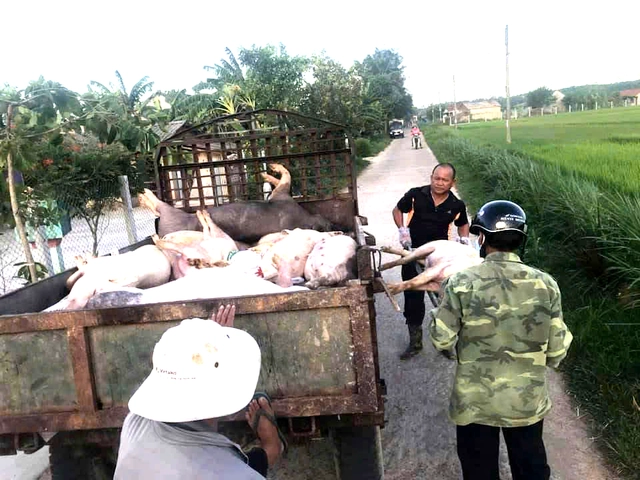
ASF continues to pose a serious threat to the pig industry and the food supply chain.





The Cebu City Government in the Philippines has temporarily banned the entry of live pigs and pork products and by-products from Negros Island and other areas in the country affected by African swine fever (ASF) to prevent the disease from reaching the city, as reported by CDN Digital.
Mayor Nestor Archival signed Executive Order No 86 on July 10, 2026, directing stricter biosecurity, quarantine, and monitoring measures to protect the local pig industry and food supply.
“ASF continues to pose a serious threat to the pig industry and the food supply chain, thereby necessitating immediate preventive and containment measures,” part of the order reads.
Movement restrictions


Under the order, Cebu City temporarily suspended the movement of live pigs and pork products and by-products from Negros Island and other ASF-affected areas.
Exemptions may be granted only when shipments comply with national laws and are backed by complete veterinary permits, shipping documents, laboratory certifications, and other required biosecurity clearances.
The order also directed the Department of Veterinary Medicine and Fisheries (DVMF), the Cebu City ASF Task Force, and other concerned offices to strictly enforce the restrictions.
These offices include the Department of Agriculture, Bureau of Animal Industry, National Meat Inspection Service, Provincial Veterinary Office, Philippine National Police, Philippine Coast Guard, Cebu Port Authority.
Requirements for businesses
The order likewise required businesses involved in selling, processing, storing, or distributing pork products to observe stricter compliance with animal health regulations.
Public markets, slaughterhouses, meat shops, supermarkets, groceries, restaurants, hotels, and similar establishments must keep updated veterinary health certificates, shipping permits, meat inspection certificates, and other documents proving the lawful source, transport, and safety of their products.
Business owners, operators, and employees must also report suspected ASF cases or violations to the DVMF and the Cebu City ASF Task Force within 24 hours of discovery.
The reporting requirement covers unusual pig deaths, animals showing symptoms consistent with ASF, undocumented swine or pork products, and other violations of the executive order.
Businesses that fail to comply may face closure, seizure and disposal of non-compliant products, suspension or non-renewal of business permits, administrative sanctions, and possible criminal charges under existing laws.
City ASF task force
The executive order also established the Cebu City ASF Task Force to oversee the planning, implementation, monitoring, and enforcement of disease prevention and containment measures across the city.
The DVMF will chair the task force, joined by representatives from the City Agriculture Office, Cebu City Disaster Risk Reduction and Management Office, City Legal Office, Cebu City Police Office, City Traffic Operations Management Office, Bantay Dagat, and the Public Information Office.
The Bureau of Animal Industry–Veterinary Quarantine Services Region VII, Department of Agriculture, Cebu Port Authority, Philippine Coast Guard, Cebu City Hog Raisers Association, and Central Visayas Pork Producers Association will also be part of the task force.
The task force will conduct inspections, enforce quarantine and biosecurity measures, issue public advisories, recommend additional actions, and regularly report on Cebu City’s ASF prevention efforts.
Follows Capitol’s earlier directive
Cebu City’s action followed an earlier issuance by the Cebu Provincial Government, which imposed a 45-day ban on the entry of live pigs, fresh pork, and processed pork products from Negros Island and other ASF-affected areas.
Governor Pamela Baricuatro signed Executive Order No. 39 on July 7, 2026, describing the restriction as a preventive measure to keep Cebu free from ASF.
The tighter border controls followed confirmed ASF cases reported in San Enrique, Negros Occidental, in late June and in Bacolod City and La Libertad, Negros Oriental, in early July.
This prompted Cebu authorities to strengthen preventive measures before any local outbreak is detected.




Subscribe now to the technical pig magazine
AUTHORS

Bifet Gracia Farm & Nedap – Automated feeding in swine nurseries

The importance of Water on pig farms
Fernando Laguna Arán
Microbiota & Intestinal Barrier Integrity – Keys to Piglet Health
Alberto Morillo Alujas
Impact of Reducing Antibiotic use, the Dutch experience
Ron Bergevoet
The keys to successful Lactation in hyperprolific sows
Mercedes Sebastián Lafuente
Addressing the challenge of Management in Transition
Víctor Fernández Segundo
Dealing with the rise of Swine Dysentery
Roberto M. C. Guedes
Actinobacillus pleuropneumoniae – What are we dealing with?
Marcelo Gottschalk
The new era of Animal Welfare in Pig Production – Are we ready?
Antonio Velarde
Gut health in piglets – What can we do to measure and improve it?
Alberto Morillo Alujas
Interview with Cristina Massot – Animal Health in Europe after April 2021
Cristina Massot
Differential diagnosis of respiratory processes in pigs
Desirée Martín Jurado Gema Chacón Pérez