Several Southeast Asian countries, including the Philippines and Vietnam, continue to depend on imported pork.




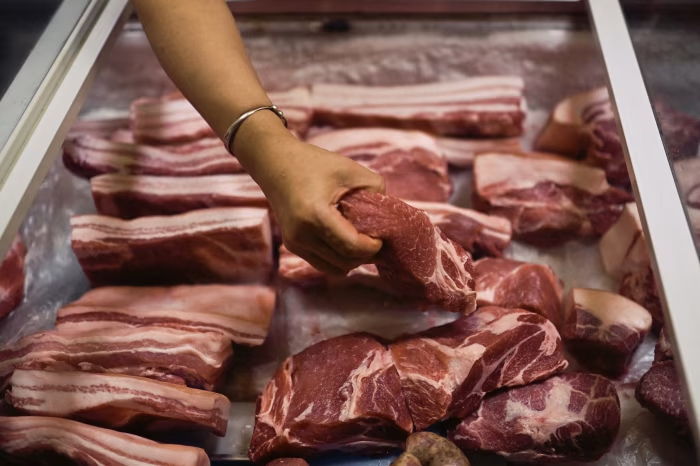
The global pork industry is entering a period of significant change as international trade patterns continue to evolve, according to a new report from RaboResearch.
For many years, China played a dominant role in global pork demand, especially during and after the African swine fever outbreak. However, changing market conditions are creating a more balanced trading environment and opening opportunities in other regions.
“Global pork trade has clearly moved away from the China-centric model that defined the previous decade,” said Éva Gocsik, Global Head of Animal Protein at RaboResearch.
“A broader range of importing countries now determines market opportunities.”


China rebuilds domestic pork production
As China rebuilds and strengthens its domestic pork production, its reliance on imported pork has declined.
While China remains one of the world’s largest pork importers, its reduced share of global imports has encouraged exporters to look for new markets.
This shift is changing the direction of global pork trade and increasing competition among major exporting countries.
New markets
Mexico has emerged as an important destination for pork exports and is now one of the leading importers of pork meat.
At the same time, several Southeast Asian countries, including the Philippines and Vietnam, continue to depend on imported pork due to animal disease challenges and limitations in domestic production.
These countries are becoming key growth markets for exporters seeking to expand their global presence.
Competition is becoming stronger
Competition among exporting nations is also becoming stronger.
The EU remain a major pork exporter, but rising production costs, environmental regulations, and animal welfare requirements have slowed growth.
Meanwhile, the US continues to strengthen its position in global markets and is expected to become an even stronger competitor in the years ahead.
Brazil has also improved its standing in the international pork sector by expanding exports to a wider range of countries.
Diversifying export destinations has helped reduce dependence on any single market and has created new opportunities for growth.
Other important factors
In addition to supply and demand factors, animal health concerns, government policies, trade agreements, tariffs, and geopolitical developments are playing a larger role in shaping global pork trade.
These factors can influence market access, competitiveness, and profitability for producers and exporters.


Subscribe now to the technical pig magazine
AUTHORS

Bifet Gracia Farm & Nedap – Automated feeding in swine nurseries

The importance of Water on pig farms
Fernando Laguna Arán
Microbiota & Intestinal Barrier Integrity – Keys to Piglet Health
Alberto Morillo Alujas
Impact of Reducing Antibiotic use, the Dutch experience
Ron Bergevoet
The keys to successful Lactation in hyperprolific sows
Mercedes Sebastián Lafuente
Addressing the challenge of Management in Transition
Víctor Fernández Segundo
Dealing with the rise of Swine Dysentery
Roberto M. C. Guedes
Actinobacillus pleuropneumoniae – What are we dealing with?
Marcelo Gottschalk
The new era of Animal Welfare in Pig Production – Are we ready?
Antonio Velarde
Gut health in piglets – What can we do to measure and improve it?
Alberto Morillo Alujas
Interview with Cristina Massot – Animal Health in Europe after April 2021
Cristina Massot
Differential diagnosis of respiratory processes in pigs
Desirée Martín Jurado Gema Chacón Pérez


To provide the best experiences, we use technologies like cookies...