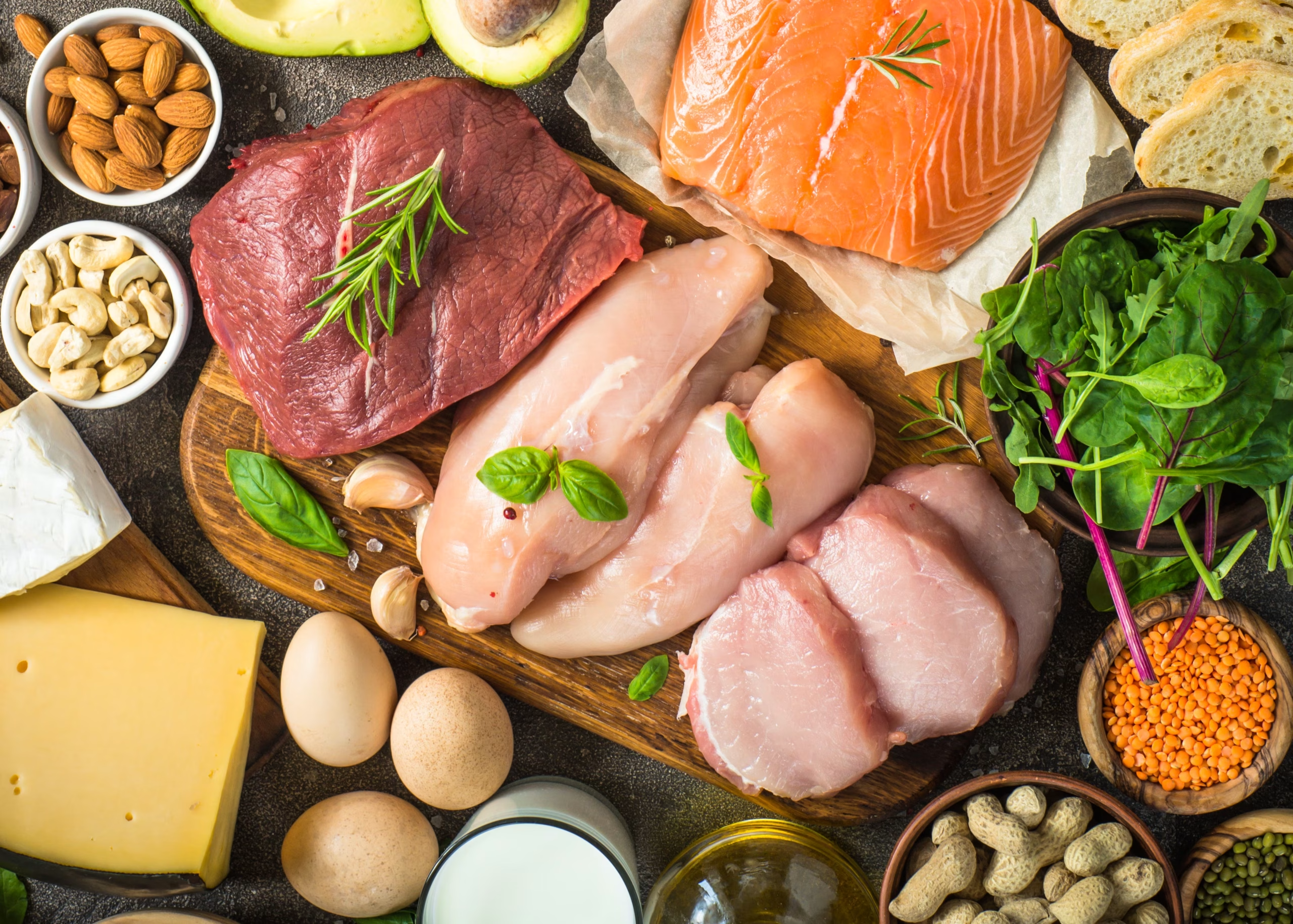
Price-sensitive consumers continue to favor pork and chicken over beef, keeping demand firm despite inflation and rising household costs.

Japan’s pork industry is expected to remain stable in 2026, with production, consumption, and imports projected at levels similar to 2025. The latest GAIN report by the USDA-FAS noted that high costs and limited expansion opportunities continue to shape the sector.
Heat, costs, and production pressures
Extreme heat in 2025 reduced breeding rates and piglet production, while imports of breeding pigs declined. Producers are maintaining current operational scales rather than expanding.
Slaughter numbers are forecast to remain steady in 2026, keeping pork production flat. Domestic carcass prices stayed high in 2025, reflecting strong demand and reduced shipments.


Elevated feed and energy costs, combined with soaring construction expenses, discourage expansion. Producers are expected to focus on efficiency rather than growth.
Consumers keep pork on the table
Pork consumption in 2026 is projected to hold at 2025 levels. Price-sensitive consumers continue to favor pork and chicken as affordable substitutes for beef.
Retail pork purchases rose 2% year-on-year in 2025, while processed pork products declined due to higher raw material costs. Dining-out frequency fell in some segments as higher per-customer spending limited visits.
Trade shifts after Spanish ASF ban
Japan’s pork imports are expected to remain flat in 2026 despite disruptions in supply. The USDA-FAS report highlighted the November 2025 suspension of Spanish pork imports, following African swine fever (ASF) confirmation, which removed a major supplier.
Spain had accounted for 15% of total imports and 30% of frozen pork imports. Japanese companies are diversifying sourcing, turning to South America while maintaining imports from North America.
Frozen pork imports decreased 9% in 2025, while chilled pork faced downward pressure from premium pricing. Brazilian pork imports rose significantly, largely substituting for European supply. US pork shipments declined due to high domestic prices and unfavorable exchange rates.

Subscribe now to the technical pig magazine
AUTHORS

Bifet Gracia Farm & Nedap – Automated feeding in swine nurseries

The importance of Water on pig farms
Fernando Laguna Arán
Microbiota & Intestinal Barrier Integrity – Keys to Piglet Health
Alberto Morillo Alujas
Impact of Reducing Antibiotic use, the Dutch experience
Ron Bergevoet
The keys to successful Lactation in hyperprolific sows
Mercedes Sebastián Lafuente
Addressing the challenge of Management in Transition
Víctor Fernández Segundo
Dealing with the rise of Swine Dysentery
Roberto M. C. Guedes
Actinobacillus pleuropneumoniae – What are we dealing with?
Marcelo Gottschalk
The new era of Animal Welfare in Pig Production – Are we ready?
Antonio Velarde
Gut health in piglets – What can we do to measure and improve it?
Alberto Morillo Alujas
Interview with Cristina Massot – Animal Health in Europe after April 2021
Cristina Massot
Differential diagnosis of respiratory processes in pigs
Desirée Martín Jurado Gema Chacón Pérez