The findings confirm that mycotoxin pressure remains a persistent and performance-limiting challenge for producers globally, Cargill said.

Multi-mycotoxin contamination continues to be a defining feature of global feed risk, according to the 2025 Global Mycotoxin Report published March 11 by Cargill Micronutrition & Health Solutions.
The 2025 report, among the most comprehensive analyses of mycotoxin contamination in animal feed ingredients around the world, is based on 389,926 analyses conducted across 41 countries.
The findings confirm that mycotoxin pressure remains a persistent and performance-limiting challenge for producers globally, Cargill said.
“Producers are not facing isolated toxin events,” said Clement Soulet, Category Lead of Anti-mycotoxin Agents at Cargill Micronutrition & Health Solutions. “They are managing multiple and regionalized risk patterns.”


Of the samples tested, 71% were positive for at least one mycotoxin above the detection limit, according to the report.
Cargill’s performance-based risk thresholds, levels associated with measurable impacts on animal productivity, were exceeded by 34% of the samples.
Three or more contaminants were found in 47% of tested samples, reinforcing the need for comprehensive risk management strategies, Cargill said.
“Our data shows that performance impact is the real concern,” Mr Soulet said. “That is why we apply solutions based on performance rather than focusing solely on regulatory minimums.”
The report highlights significant regional variation in toxin prevalence:
These regional differences underscore the importance of localized testing, interpretation, and mitigation strategies in partnership with a mycotoxin specialist.
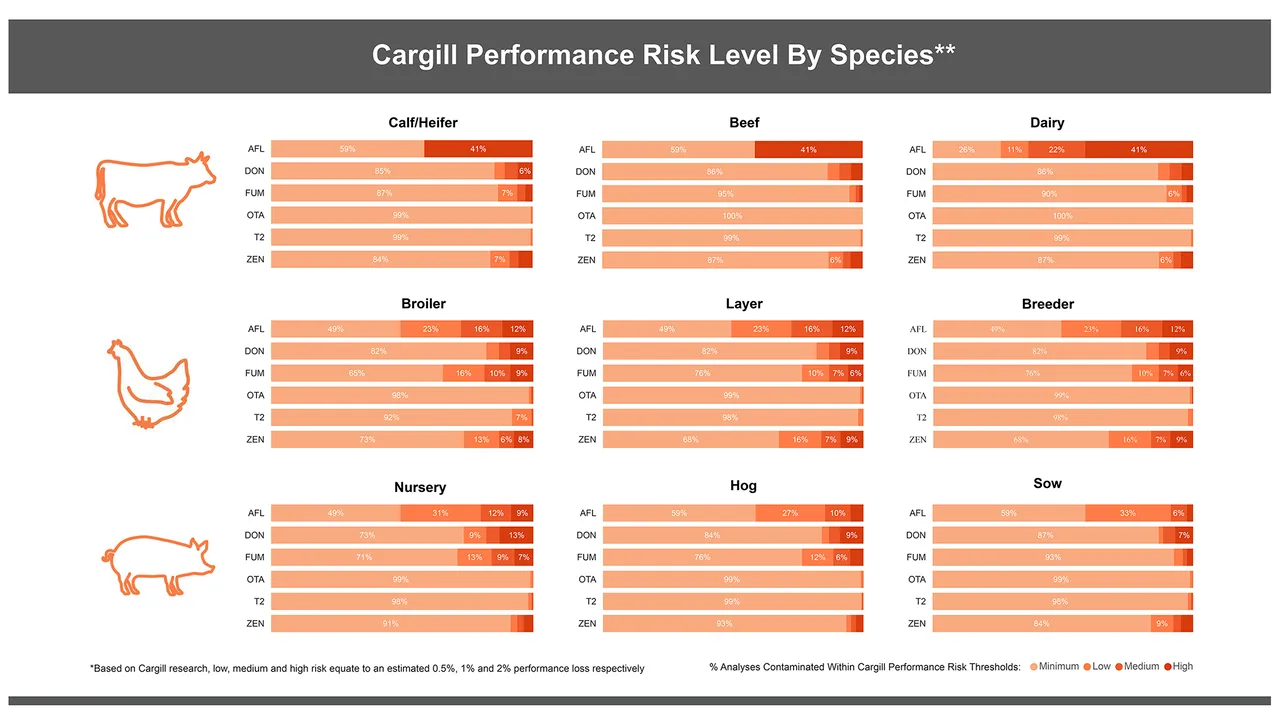
The report also evaluates risk through the lens of animal performance:
Across species, DON and ZEN remain leading contributors to performance variability, affecting gut integrity, immune resilience, reproductive performance and feed efficiency, according to the report.
The findings are part of Cargill Micronutrition & Health Solutions dedicated mycotoxin management offerings, which integrate diagnostics led by technical experts, data interpretation in the context of global and regional trends, and species-specific mitigation solutions.
“Effective mycotoxin management requires more than mitigation,” Mr Soulet said. “It requires data-driven decisions. Our goal is to help producers translate global insight into practical, performance-focused action.”
The full 2025 Global Mycotoxin Report is available at mycotoxins.com

Subscribe now to the technical pig magazine
AUTHORS

Bifet Gracia Farm & Nedap – Automated feeding in swine nurseries

The importance of Water on pig farms
Fernando Laguna Arán
Microbiota & Intestinal Barrier Integrity – Keys to Piglet Health
Alberto Morillo Alujas
Impact of Reducing Antibiotic use, the Dutch experience
Ron Bergevoet
The keys to successful Lactation in hyperprolific sows
Mercedes Sebastián Lafuente
Addressing the challenge of Management in Transition
Víctor Fernández Segundo
Dealing with the rise of Swine Dysentery
Roberto M. C. Guedes
Actinobacillus pleuropneumoniae – What are we dealing with?
Marcelo Gottschalk
The new era of Animal Welfare in Pig Production – Are we ready?
Antonio Velarde
Gut health in piglets – What can we do to measure and improve it?
Alberto Morillo Alujas
Interview with Cristina Massot – Animal Health in Europe after April 2021
Cristina Massot
Differential diagnosis of respiratory processes in pigs
Desirée Martín Jurado Gema Chacón Pérez