


Multi-mycotoxin contamination continues to be a defining feature of global feed risk, according to the 2025 Global Mycotoxin Report published March 11 by Cargill Micronutrition & Health Solutions.
The 2025 report, among the most comprehensive analyses of mycotoxin contamination in animal feed ingredients around the world, is based on 389,926 analyses conducted across 41 countries.
The findings confirm that mycotoxin pressure remains a persistent and performance-limiting challenge for producers globally, Cargill said.
“Producers are not facing isolated toxin events,” said Clement Soulet, Category Lead of Anti-mycotoxin Agents at Cargill Micronutrition & Health Solutions. “They are managing multiple and regionalized risk patterns.”
Of the samples tested, 71% were positive for at least one mycotoxin above the detection limit, according to the report.
Cargill’s performance-based risk thresholds, levels associated with measurable impacts on animal productivity, were exceeded by 34% of the samples.
- ✅ Deoxynivalenol (DON) remains the most prevalent and highest global performance risk, with 53% of analyses above performance thresholds.
- ✅ Fumonisins (FUM) increased in risk compared to the previous year.
- ✅ Zearalenone (ZEN) remains consistently high across multiple regions.
Three or more contaminants were found in 47% of tested samples, reinforcing the need for comprehensive risk management strategies, Cargill said.
“Our data shows that performance impact is the real concern,” Mr Soulet said. “That is why we apply solutions based on performance rather than focusing solely on regulatory minimums.”
The report highlights significant regional variation in toxin prevalence:
- ✅ North America and China continue to experience high DON pressure.
- ✅ Parts of the Americas and Asia show elevated FUM prevalence.
- ✅ ZEN remains consistently high in several European and Middle East and Africa markets.
- ✅ Aflatoxin (AFL) pressure increased in parts of Asia compared to the prior year.
These regional differences underscore the importance of localized testing, interpretation, and mitigation strategies in partnership with a mycotoxin specialist.
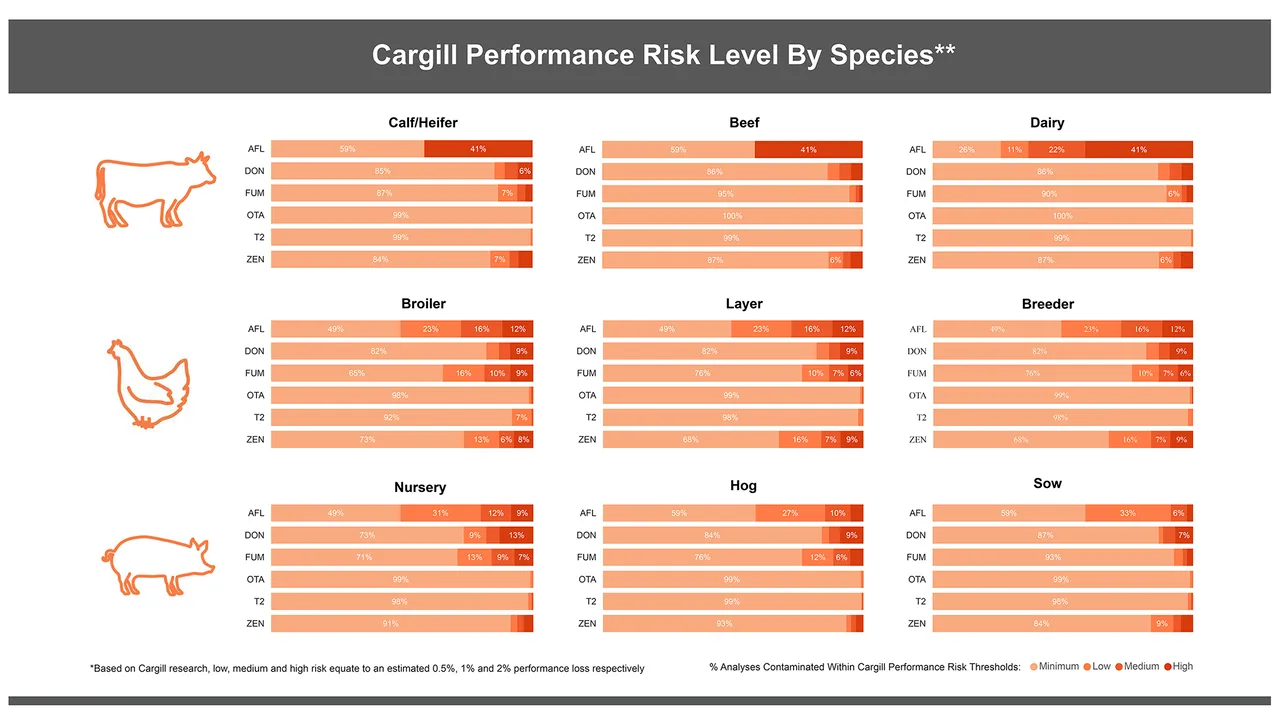
The report also evaluates risk through the lens of animal performance:
- ✅ 17% of samples exceeded performance thresholds for calves and heifers.
- ✅ 27% exceeded broiler performance thresholds.
- ✅ 26% exceeded nursery pig performance thresholds.
Across species, DON and ZEN remain leading contributors to performance variability, affecting gut integrity, immune resilience, reproductive performance and feed efficiency, according to the report.

The findings are part of Cargill Micronutrition & Health Solutions dedicated mycotoxin management offerings, which integrate diagnostics led by technical experts, data interpretation in the context of global and regional trends, and species-specific mitigation solutions.
“Effective mycotoxin management requires more than mitigation,” Mr Soulet said. “It requires data-driven decisions. Our goal is to help producers translate global insight into practical, performance-focused action.”
The full 2025 Global Mycotoxin Report is available at mycotoxins.com