


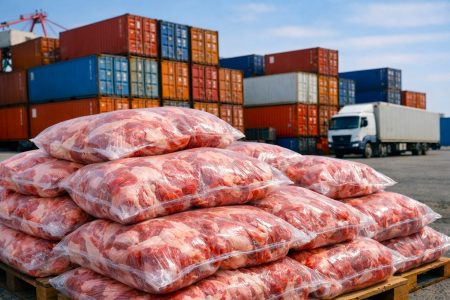
Philippine meat imports crossed 1,021,772 tons by July 2026, underscoring the scale of foreign supply entering the market. Data from the Bureau of Animal Industry show that monthly arrivals ranged between 137,000 (June) and 157,000 tons (May), showing consistent inflows across the first seven months. Pork dominated shipments at 541,406 tons, followed by chicken at 335,670 tons and beef at 110,571 tons. Smaller volumes of buffalo, duck, lamb, and turkey rounded out the total.
Chicken imports were led by mechanically deboned meat, which reached 195,370 tons, reflecting its importance in processed foods. Pork imports were more diversified, spanning cuts, bellies, fats, offals, and rind/skin. Cuts alone accounted for 233,116 tons, while offals added 162,746 tons. Bellies contributed 77,445 tons, fats 43,992 tons, and rind/skin 24,019 tons.
Structural weaknesses in local production
This reliance on imports highlights a structural weakness: domestic herds remain slow to recover from African swine fever. Government programs intended to rebuild hog populations have lagged, leaving farms vulnerable and discouraging investment. Producers argue that without faster repopulation, imports will continue to fill the gap, eroding competitiveness and weakening long‑term resilience.
The pace of swine repopulation has become a central concern. Farmers expected stronger government support to restore herds, yet implementation has been slow. This delay prolongs dependence on imports and undermines confidence in recovery. Producers warn that uncertainty discourages expansion, leaving the industry exposed to further shocks.
Brazil leads the pack
Country‑level data show Brazil as the dominant supplier, shipping 257,728 tons of pork by July—nearly half of total pork imports. Spain contributed 25,527 tons, Canada 17,516 tons, and Germany 12,463 tons. The US supplied 26,858 tons, while Denmark, the Netherlands, and Poland also provided notable volumes.
The diversity of sources reflects a deliberate strategy to spread supply risks. Yet Brazil’s dominance underscores dependence on a single major partner. Any disruption in Brazilian exports could significantly affect local availability, raising questions about resilience and food security.
Risk of surplus as imports continue
Ironically, while producers warn of shortages, industry groups caution that a surplus could emerge later in 2026. Projections suggest that combined imports and recovering local output could push pork supply close to one million tons. Such a level would exceed demand, potentially depressing farm‑gate prices and hurting producers.
Eric Harina, President of the Pork Producers Federation of the Philippines, has emphasized that if imports continue at their current pace while herds rebound, the country could face oversupply. He warned that this situation would depress farm‑gate prices and undermine producers who are only beginning to recover.
This scenario illustrates the danger of misaligned policies. Heavy imports may be necessary in the short term, but if they continue unchecked while herds rebound, the market could swing from deficit to oversupply. Farmers would then face losses, discouraging further investment and slowing recovery.
Policy crossroads
The industry now stands at a crossroads. Imports have provided immediate relief, ensuring stable prices and consistent supply. But delays in repopulation programs threaten long‑term sustainability, while the risk of surplus looms if imports remain high. Policymakers must balance affordability for consumers with viability for producers.
The challenge lies in calibration. Expanding imports may ease prices today but undermine farmers tomorrow. Conversely, slow repopulation prolongs dependence on foreign supply. Effective coordination is essential to avoid destabilizing swings between shortage and surplus.
Balancing benefits and risks
Consumers benefit from stable prices and steady supply, thanks to imports. Farmers, however, face uncertainty. Delays in repopulation and the threat of surplus make investment risky. Without clear policy direction, the industry risks oscillating between extremes, undermining both producers and consumers.
Accelerating repopulation programs while moderating imports offers a path forward. Success will depend on timely action, transparent coordination, and sustained support for local producers. Without these measures, the country’s pork industry may remain trapped in cycles of instability, with consequences for food security and rural livelihoods.