The Philippines lifted its ban on German pork imports after ASF regionalization, aiming to stabilize supply while protecting local farmers.

The Philippines has lifted the temporary ban on pork imports from Germany after formally recognizing its African Swine Fever (ASF) regionalization.
Germany’s veterinary authorities demonstrated strong control measures against ASF, and the Bureau of Animal Industry confirmed a low risk of transmission from recognized zones. This assessment paved the way for renewed trade between the two countries.
The lifting of the ban is expected to ease supply pressures in the Philippines, where pig producers continue to face rising feed and fuel costs. The decision comes at a time when local supply chains remain vulnerable, and imports are seen as a potential stabilizer.
Under the new rules from the Department of Agriculture (DA), pork products must originate strictly from ASF-free regions. Transport will be conducted using sealed vehicles that deliver directly to approved slaughterhouses. Animals must undergo both ante-mortem and post-mortem inspections, while veterinary authorities are required to provide detailed ASF surveillance reports to ensure compliance.


Local farmers, however, remain cautious. They emphasize that imports should complement domestic production rather than displace it. Their concerns focus on protecting farmgate prices and ensuring fair competition in the market.
The DA stressed that all import transactions must follow bilaterally agreed terms on regionalization, alongside existing rules and regulations. These safeguards are designed to protect public health and maintain confidence in the country’s pork supply chain.
By enforcing strict conditions, the government aims to reassure consumers and producers that imported pork will not compromise disease control measures.
Industry groups acknowledge that imports may help stabilize supply but insist that government support remains essential. Subsidies for feed and transport are viewed as necessary to offset rising costs and sustain local operations.
Smooth coordination between regulators and producers will be critical. Farmers argue that without safeguards and support, imports could undermine recovery efforts and weaken the domestic hog industry.
The decision highlights the Philippines’ effort to balance food security with international trade obligations. By recognizing Germany’s ASF regionalization, the DA affirms confidence in veterinary oversight while reinforcing agricultural cooperation between the two countries.

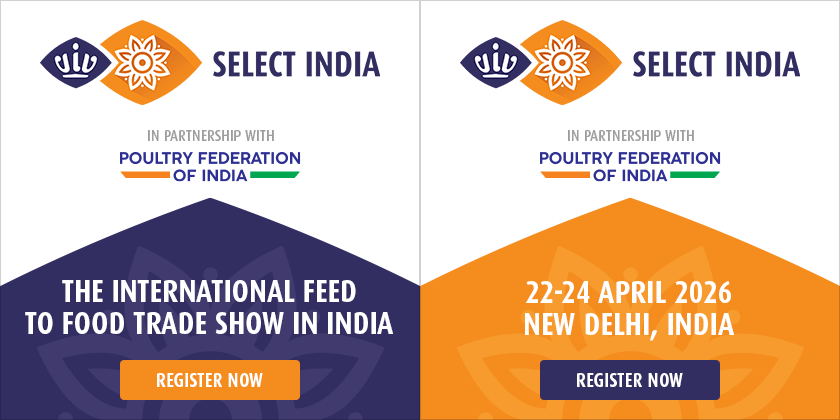

Subscribe now to the technical pig magazine
AUTHORS

Bifet Gracia Farm & Nedap – Automated feeding in swine nurseries

The importance of Water on pig farms
Fernando Laguna Arán
Microbiota & Intestinal Barrier Integrity – Keys to Piglet Health
Alberto Morillo Alujas
Impact of Reducing Antibiotic use, the Dutch experience
Ron Bergevoet
The keys to successful Lactation in hyperprolific sows
Mercedes Sebastián Lafuente
Addressing the challenge of Management in Transition
Víctor Fernández Segundo
Dealing with the rise of Swine Dysentery
Roberto M. C. Guedes
Actinobacillus pleuropneumoniae – What are we dealing with?
Marcelo Gottschalk
The new era of Animal Welfare in Pig Production – Are we ready?
Antonio Velarde
Gut health in piglets – What can we do to measure and improve it?
Alberto Morillo Alujas
Interview with Cristina Massot – Animal Health in Europe after April 2021
Cristina Massot
Differential diagnosis of respiratory processes in pigs
Desirée Martín Jurado Gema Chacón Pérez