How mycotoxins continue to shape livestock health, productivity, and global food security.





Mycotoxins represent one of the most significant biological hazards affecting global feed safety.
Produced as secondary metabolites by filamentous fungi, these compounds compromise animal health through complex biochemical mechanisms that impair nutrient utilization, immune competence, intestinal integrity, and metabolic function.
Their widespread occurrence across cereal grains and feed ingredients makes chronic exposure a persistent risk in modern livestock production systems, often resulting in substantial economic losses long before overt clinical signs become apparent.
Produced naturally by certain molds that grow on grains and feed ingredients, these toxic compounds compromise animal health, reduce production efficiency, and increase disease susceptibility across poultry, swine, dairy, aquaculture, and ruminant systems.

Unlike many infectious diseases, mycotoxin contamination often develops silently. Animals may continue eating contaminated feed while experiencing gradual reductions in growth rate, reproductive performance, feed efficiency, and immune competence. By the time clinical signs become obvious, significant economic losses may already have occurred.
As climate variability, global grain trade, and complex feed supply chains continue to evolve, managing mycotoxin has become a strategic priority for livestock producers worldwide.
Understanding mycotoxins
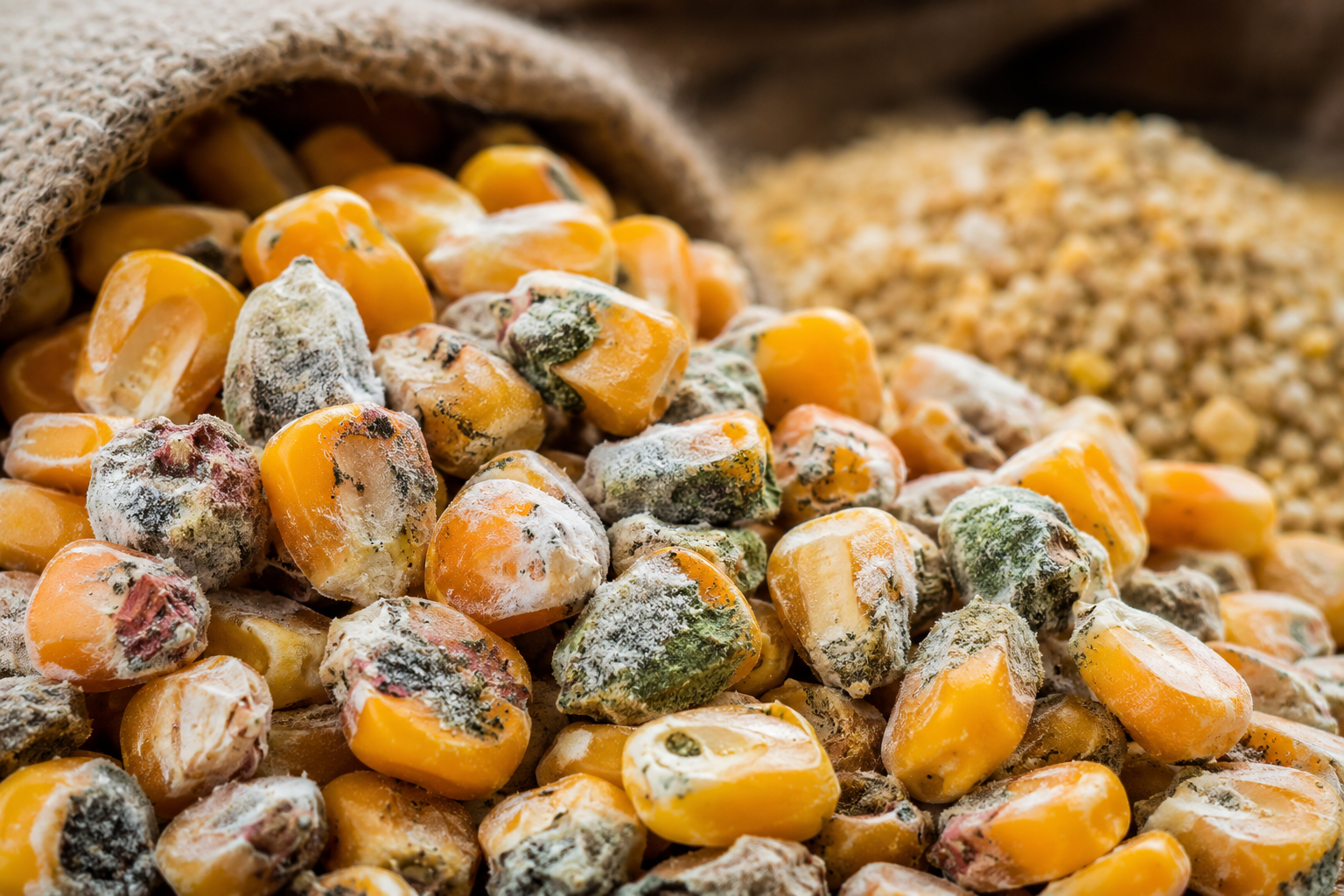
Mycotoxins are toxic secondary metabolites produced by fungi belonging primarily to the genera Aspergillus, Fusarium, and Penicillium. Hundreds of mycotoxins have been identified, although only a relatively small number are considered major threats to commercial livestock production.
Among the most economically significant are:
Each toxin affects different physiological systems, but collectively they reduce productivity, increase veterinary costs, and compromise profitability.
Why feed becomes contaminated
Fungal growth is influenced by a combination of environmental conditions including temperature, moisture, humidity, oxygen availability, and crop damage. Contamination can begin before harvest and continue during harvesting, transportation, storage, and feed manufacturing.
Changing weather patterns have further complicated this challenge. Extended rainfall, drought stress, fluctuating temperatures, and inadequate storage conditions can all increase the likelihood of fungal proliferation and subsequent toxin production.
Because contamination may occur at multiple stages of the feed chain, prevention requires continuous monitoring rather than isolated interventions.
A widespread global concern
Surveillance programs conducted across different regions consistently demonstrate that mycotoxin contamination is far more common than many producers expect.
Large-scale feed analyses frequently report detectable levels of one or more mycotoxin in the vast majority of samples, while a substantial proportion exceed concentrations capable of affecting animal performance even without causing obvious clinical disease.
Commonly affected feed ingredients include maize, peanut meal, soybean meal, distillers dried grains with soluble’s (DDGS), corn gluten products, and cereal by-products.
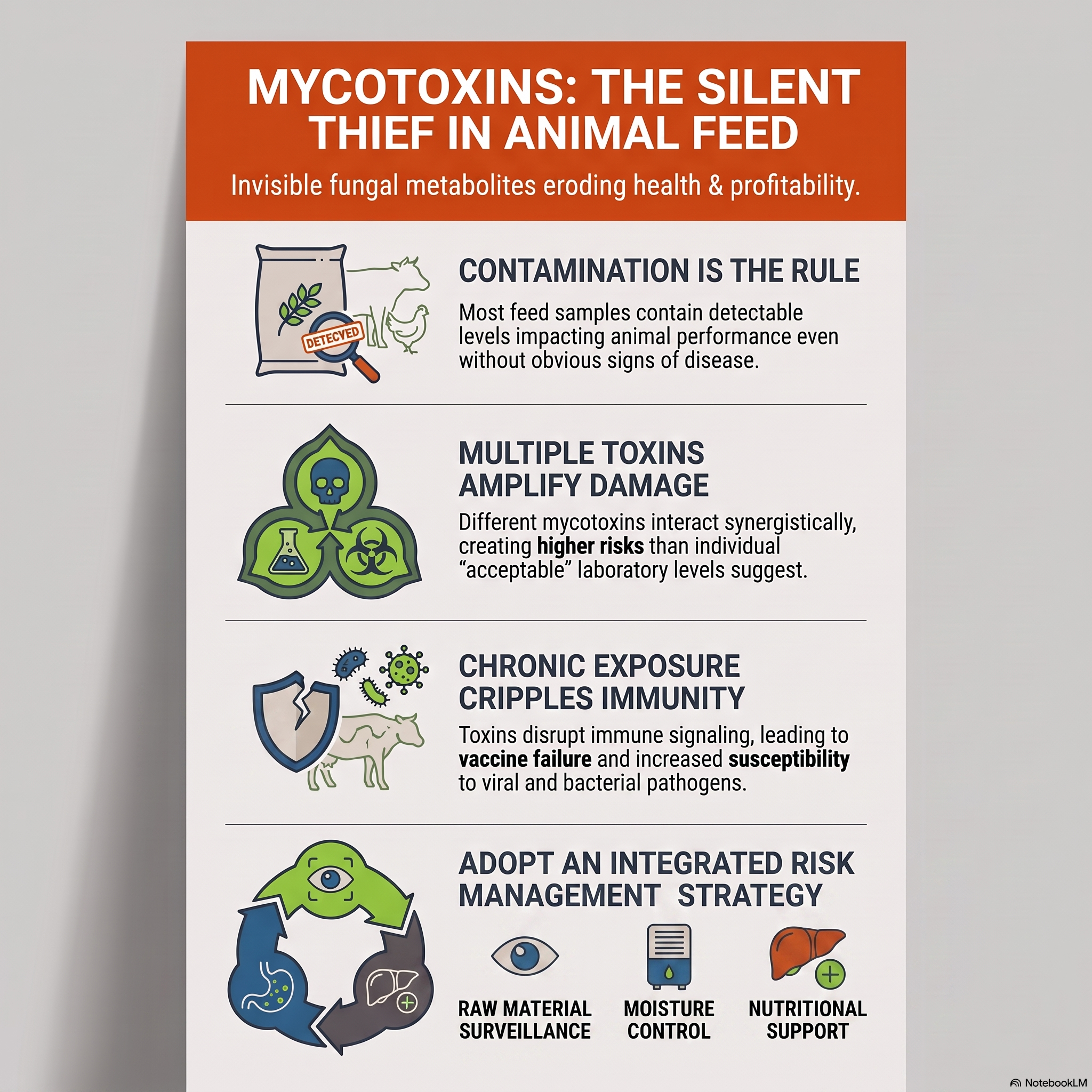
These findings reinforce an important industry reality: contamination is often the rule rather than the exception.
Feed safety today is no longer simply about nutrient formulation—it is increasingly about effective risk management.
When multiple toxins work together
Perhaps the greatest challenge lies not in individual toxins but in their combined effects.
Commercial feed rarely contains a single mycotoxin. Instead, animals are commonly exposed to multiple contaminants simultaneously. These compounds may interact additively or synergistically, amplifying their biological effects even when each toxin is present at relatively low concentrations.
This complexity explains why laboratory analyses showing ‘acceptable’ concentrations of individual toxins do not always correspond with field performance.
Understanding multi-mycotoxin exposure has become one of the most active areas of research in animal nutrition and feed safety.
The biological cost of chronic exposure
The effects of mycotoxins extend far beyond reduced feed intake.
Poultry
Producers may observe:
Swine
Common consequences include:
Although symptoms vary according to species, toxin type, and exposure level, the cumulative result is consistently reduced production efficiency.
Immunomodulatory effects of chronic mycotoxin exposure
Chronic exposure to mycotoxins has profound implications for immune competence. Several major mycotoxins interfere with both innate and adaptive immune responses by disrupting cytokine signaling, impairing macrophage and lymphocyte function, and increasing oxidative stress.
Consequently, exposed animals frequently exhibit reduced vaccine responsiveness, increased susceptibility to bacterial and viral pathogens, prolonged recovery following disease challenge, and greater dependence on therapeutic interventions.
These immunomodulatory effects often occur at toxin concentrations insufficient to produce overt clinical toxicosis, making subclinical exposure one of the most economically significant consequences of feed contamination.
Integrated nutritional strategies for mycotoxin risk mitigation
Complete elimination of mycotoxin contamination is rarely achievable because fungal growth and toxin production may occur at multiple stages of the feed supply chain. Consequently, contemporary mitigation programs emphasize risk reduction through integrated nutritional and management strategies rather than reliance on a single intervention.
Recommended approaches include rigorous raw material surveillance, optimized grain storage practices, incorporation of mold-control technologies, broad-spectrum mycotoxin mitigation agents, targeted antioxidant supplementation, hepatic support, and nutritional programs designed to preserve intestinal barrier integrity and microbial homeostasis.
Collectively, these measures enhance animal resilience while minimizing the physiological consequences of chronic toxin exposure.
Current best practices may include:
Rather than relying on a single intervention, most experts advocate integrated programs that combine prevention, monitoring, and nutritional support.
An integrated risk management approach
Successful mycotoxin management is increasingly viewed as a systems approach rather than a single-product solution.
An effective program generally includes four complementary objectives:
Such integrated strategies recognize that feed safety begins long before feed reaches the animal.
Future perspectives
Increasing climate variability, evolving fungal ecology, and the globalization of feed ingredient supply chains are expected to further influence the prevalence and geographical distribution of mycotoxin. Consequently, effective mycotoxin management is transitioning from a reactive practice to a proactive component of precision livestock nutrition.
Future advances will increasingly depend on integrated surveillance systems, rapid analytical diagnostics, predictive risk modelling, and scientifically validated mitigation strategies capable of addressing the complex interactions associated with multi-mycotoxin exposure.
Protecting animal health and production efficiency will therefore require a multidisciplinary approach that combines feed science, nutrition, veterinary medicine, and supply chain management.



Subscribe now to the technical pig magazine
AUTHORS

Bifet Gracia Farm & Nedap – Automated feeding in swine nurseries

The importance of Water on pig farms
Fernando Laguna Arán
Microbiota & Intestinal Barrier Integrity – Keys to Piglet Health
Alberto Morillo Alujas
Impact of Reducing Antibiotic use, the Dutch experience
Ron Bergevoet
The keys to successful Lactation in hyperprolific sows
Mercedes Sebastián Lafuente
Addressing the challenge of Management in Transition
Víctor Fernández Segundo
Dealing with the rise of Swine Dysentery
Roberto M. C. Guedes
Actinobacillus pleuropneumoniae – What are we dealing with?
Marcelo Gottschalk
The new era of Animal Welfare in Pig Production – Are we ready?
Antonio Velarde
Gut health in piglets – What can we do to measure and improve it?
Alberto Morillo Alujas
Interview with Cristina Massot – Animal Health in Europe after April 2021
Cristina Massot
Differential diagnosis of respiratory processes in pigs
Desirée Martín Jurado Gema Chacón Pérez


To provide the best experiences, we use technologies like cookies...