The sector must move beyond scale, and prioritize added value, standardized processes, and sustainability to compete in global markets.





Vietnam’s livestock sector is entering a new phase of growth. To remain competitive, it must shift from expanding production volumes to creating greater added value. This requires standardized processes, specialization at each stage, stronger biosecurity, and closer alignment with environmental responsibility.
According to Dr Pham Kim Dang, Deputy Director General of the Department of Livestock Production and Veterinary Medicine, Vietnam holds a leading position in regional and global livestock markets.
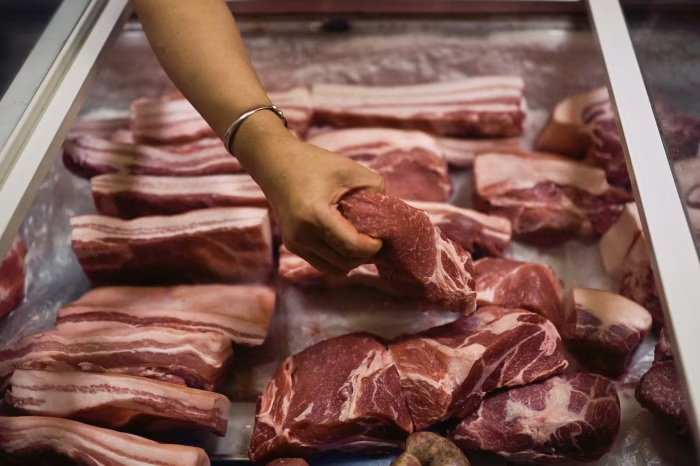
The country ranks fifth worldwide in pig numbers and sixth in pork production. Its poultry population is ninth globally, while its duck population is second.
Fresh milk production ranks third in ASEAN. Meanwhile, animal feed production is approximately 21.5 million tons, the highest in Southeast Asia and eighth globally.


Domestic supply capacity is strong. Local production meets 90.9% of pork demand, 81.8% of poultry demand, 68.5% of beef demand, and 40–45% of milk demand. Egg production already exceeds consumption.
International trade has also recorded positive results. Livestock product exports rose from USD 434 million in 2021 to USD 627.8 million in 2025. Feed ingredients and animal feed exports reached USD 1.6 billion. By 2030, the sector aims to raise livestock product exports to USD 1–1.5 billion.
However, large-scale production alone does not guarantee high added value. The challenge for Vietnam’s livestock sector now lies in meeting international standards and integrating more deeply into global value chains.
At the 2026 Tay Ninh Import-Export Supply Chain Connectivity Conference, Vu Manh Hung, Chairman of Hung Nhon Group, emphasized that producing quality products is not enough.
Mr Hung said that to gain deeper access to demanding markets such as Europe, Japan, and Halal markets, Vietnamese businesses must first develop the capacity to participate in value chains that meet international standards.
International markets demand stable, transparent systems capable of demonstrating consistent quality across the entire supply chain. Products must meet traceability requirements and comply with unified standards.
This means every stage—from genetics and feed to farm technology, biosecurity, animal health, and processing—must be standardized and integrated. Clear control procedures and transparent traceability are essential.
“To compete internationally, we do not necessarily have to do everything ourselves, but each link in the chain must be strong enough and connected through a common standard,” Mr Hung said.
Hung Nhon and its international partners have built an integrated production model covering genetics, feed, livestock production, processing, and distribution. Each company specializes in its area while working toward shared goals of efficiency and competitiveness.
Hung Nhon operates large-scale, high-tech farms with strong biosecurity. International partners contribute expertise:
This model shows how specialization and integration strengthen management efficiency and quality control while aligning with international standards.
Biosecurity is particularly critical in poultry production. Closed-house systems, environmental monitoring, and automated feeding improve precision and reduce risks. Disease-free zones further strengthen compliance with export requirements.
Human resources also play a key role. Farm personnel must be trained in biosecurity, animal care, and health management to maintain consistent standards.
Mr Hung stressed that livestock development must align with environmental responsibility. Technology, quality control, and standards-based production should reduce resource use, minimize environmental impact, and support sustainable growth.
He noted that ‘European standards’ are not simply a set of technical requirements for exports, but also a production model in which quality is controlled, traceability is transparent, technology is used effectively, and growth is linked to environmental responsibility.
To move from volume-driven growth to value-driven development, Vietnam’s livestock sector must strengthen cooperation among businesses, farmers, regulators, and international partners.
A common standards framework will help optimize costs, improve competitiveness, ensure quality, and expand access to demanding export markets.



Subscribe now to the technical pig magazine
AUTHORS

Bifet Gracia Farm & Nedap – Automated feeding in swine nurseries

The importance of Water on pig farms
Fernando Laguna Arán
Microbiota & Intestinal Barrier Integrity – Keys to Piglet Health
Alberto Morillo Alujas
Impact of Reducing Antibiotic use, the Dutch experience
Ron Bergevoet
The keys to successful Lactation in hyperprolific sows
Mercedes Sebastián Lafuente
Addressing the challenge of Management in Transition
Víctor Fernández Segundo
Dealing with the rise of Swine Dysentery
Roberto M. C. Guedes
Actinobacillus pleuropneumoniae – What are we dealing with?
Marcelo Gottschalk
The new era of Animal Welfare in Pig Production – Are we ready?
Antonio Velarde
Gut health in piglets – What can we do to measure and improve it?
Alberto Morillo Alujas
Interview with Cristina Massot – Animal Health in Europe after April 2021
Cristina Massot
Differential diagnosis of respiratory processes in pigs
Desirée Martín Jurado Gema Chacón Pérez


To provide the best experiences, we use technologies like cookies...