porciNews Asia

News 13 Nov



New farms, feed capacity and processing projects are positioning BAF for larger livestock production despite softer profitability.
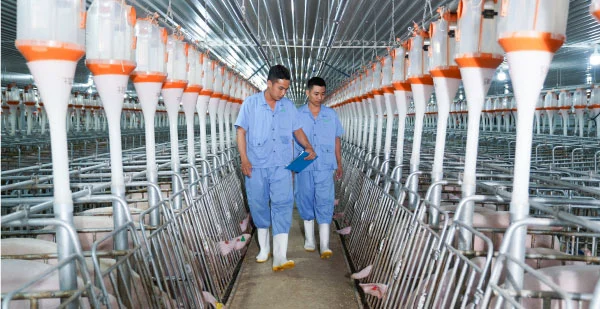
Vietnamese agribusiness BAF Vietnam Agriculture JSC is pursuing an aggressive expansion strategy that is reshaping its livestock business. While that push lifted revenue and production, it also weighed on profitability as new projects moved into operation.
According to The Investor, the company is expanding across farming, feed production and food processing as it builds a more integrated livestock platform. The strategy helped drive strong top-line growth during the first nine months of 2026, even as earnings softened.
A key part of BAF’s strategy is linking feed, farming, slaughtering and food processing within a single supply chain.
The latest move came in September with the creation of BAF Binh Dinh Food Processing Co Ltd in Gia Lai province. The wholly owned subsidiary will focus on meat processing, preservation and related products.
The company subsequently secured approval for the BAF Gia Lai Food Processing Plant. The project will require investment of about USD 48.7 million (at USD 1:VND 25,650) and will be developed in two phases. The first phase is scheduled to begin operations in July 2027, with the second following in August 2028.
Once completed, the facility will become a major processing hub. It is designed to slaughter more than one million pigs annually while handling substantial poultry volumes. The plant will also produce processed meat products and provide industrial catering services.
The investment strengthens BAF’s growing presence in Gia Lai, where it already has interests in feed, livestock and breeding operations.
The company’s growth plans extend beyond Gia Lai.
In June, BAF approved four wholly owned subsidiaries in Hanoi focused on pig farming, poultry production and food processing. It also announced plans to acquire a 97% stake in Gia Han Production and Trading Co Ltd in Quang Tri province.
Alongside those investments, BAF continues to expand production capacity. Its third feed mill has increased total designed feed output to 750,000 tons annually, supporting its Feed-Farm-Food model.
Construction is also underway on several livestock projects, including new farms in Gia Lai.
BAF’s Q3 2026 results reflected both the benefits and costs of expansion.
Net revenue reached about USD 80.7 million, up 82% from a year earlier. Net profit, however, slipped about 6% to USD 826,000.
For the first nine months of 2026, net revenue climbed roughly 63% to USD 232.4 million, while net profit fell around 9% to USD 12.9 million.
The company attributed the decline partly to higher borrowing costs and weaker market conditions. Expenses also rose as newly commissioned farms increased spending on labor, utilities, depreciation and startup activities.
Selling and administrative costs increased as well, reflecting the scale of ongoing investments.
Despite those pressures, operating performance remained strong. BAF reported pig output of about 848,000 head in the first nine months, up around 55% year on year and equal to 98% of its target.
The company plans to add 16 new farms in 2026, mainly in the Central Highlands and central Vietnam. The expansion is expected to nearly double its breeding sow herd from 2025 levels and support further growth in market hog production.
The results suggest BAF is accepting near-term earnings pressure as it invests in a larger and more integrated livestock business. Whether that strategy delivers stronger returns will depend on how quickly new assets translate into higher production and sales.



Subscribe now to the technical pig magazine
AUTHORS

Bifet Gracia Farm & Nedap – Automated feeding in swine nurseries

The importance of Water on pig farms
Fernando Laguna Arán
Microbiota & Intestinal Barrier Integrity – Keys to Piglet Health
Alberto Morillo Alujas
Impact of Reducing Antibiotic use, the Dutch experience
Ron Bergevoet
The keys to successful Lactation in hyperprolific sows
Mercedes Sebastián Lafuente
Addressing the challenge of Management in Transition
Víctor Fernández Segundo
Dealing with the rise of Swine Dysentery
Roberto M. C. Guedes
Actinobacillus pleuropneumoniae – What are we dealing with?
Marcelo Gottschalk
The new era of Animal Welfare in Pig Production – Are we ready?
Antonio Velarde
Gut health in piglets – What can we do to measure and improve it?
Alberto Morillo Alujas
Interview with Cristina Massot – Animal Health in Europe after April 2021
Cristina Massot
Differential diagnosis of respiratory processes in pigs
Desirée Martín Jurado +1


To provide the best experiences, we use technologies like cookies...