A final anti-dumping decision sharply reduces tariffs, easing pressure on European exporters and providing modest support to China’s struggling pork sector.
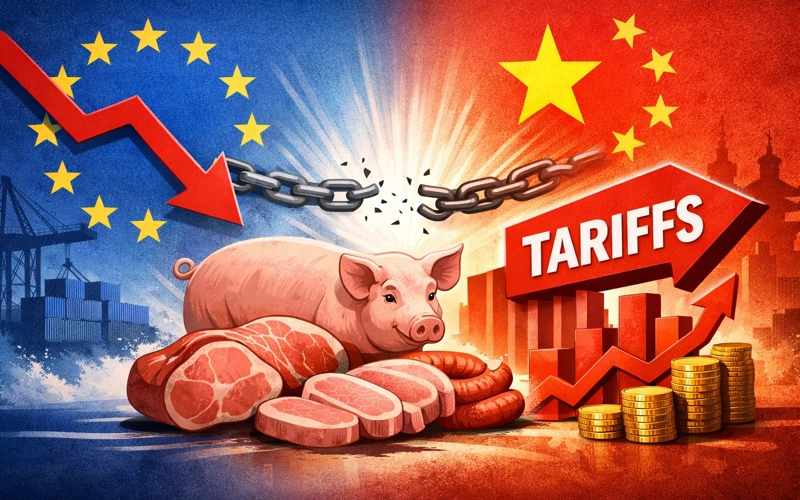
China has significantly reduced tariffs on pork imports from the EU, partially relieving European producers following an 18-month anti-dumping investigation that was widely seen as retaliation for EU duties on Chinese electric vehicles.
In its final decision, published on December 24, China’s Ministry of Commerce set new tariffs ranging from 4.9% to 19.8% on EU pork imports for a 5-year period beginning December 24.
This move marks a sharp reduction from the preliminary rates of 15.6% to 62.4% imposed in September. Importers will be refunded any difference in duties paid since the preliminary decision.
The court’s decision effects over USD 2 billion worth of EU pork exports to China and comes as a relief to producers heavily dependent on the Chinese market, particularly for offal such as pig ears and feet, for which demand elsewhere is limited.


In 2024, China imported USD 4.8 billion worth of pork and offal, more than half of which came from the EU. Spain was the bloc’s largest exporter by volume.
A ‘sense of relief’
The investigation, launched in June 2024, affected major exporters, including Spain, the Netherlands, and Denmark.
It unfolded amid broader diplomatic engagement, including renewed negotiations on electric vehicle tariffs and recent visits to Beijing by French President Emmanuel Macron and Spanish King Felipe.
Regional officials in Spain also pushed for tariff reductions, citing Spain’s openness to Chinese investment in the auto industry.
Industry groups welcomed the tariff reductions but emphasized that they still represent a cost.
The French pork producers’ association Inaporc stated that all cooperating exporters were granted a 9.8% rate, which brought a ‘sense of relief’, although the industry cannot be entirely pleased.
China’s pork sector struggles
This decision comes as China’s pork sector struggles with oversupply and weak consumer demand.
Pork prices have been falling throughout 2025 and are expected to remain under pressure.
While the tariff reduction may slightly increase imported pork prices and mitigate food price deflation, analysts say the impact is likely to be negligible, benefiting Chinese pork farmers more than price-sensitive import segments.
China continues to use trade instruments against the EU in other countries: an investigation into EU dairy export subsidies is scheduled to conclude next February, and tariffs on EU cognac have already been imposed, highlighting that trade tensions between Beijing and Brussels are far from resolved.


Subscribe now to the technical pig magazine
AUTHORS

Bifet Gracia Farm & Nedap – Automated feeding in swine nurseries

The importance of Water on pig farms
Fernando Laguna Arán
Microbiota & Intestinal Barrier Integrity – Keys to Piglet Health
Alberto Morillo Alujas
Impact of Reducing Antibiotic use, the Dutch experience
Ron Bergevoet
The keys to successful Lactation in hyperprolific sows
Mercedes Sebastián Lafuente
Addressing the challenge of Management in Transition
Víctor Fernández Segundo
Dealing with the rise of Swine Dysentery
Roberto M. C. Guedes
Actinobacillus pleuropneumoniae – What are we dealing with?
Marcelo Gottschalk
The new era of Animal Welfare in Pig Production – Are we ready?
Antonio Velarde
Gut health in piglets – What can we do to measure and improve it?
Alberto Morillo Alujas
Interview with Cristina Massot – Animal Health in Europe after April 2021
Cristina Massot
Differential diagnosis of respiratory processes in pigs
Desirée Martín Jurado Gema Chacón Pérez