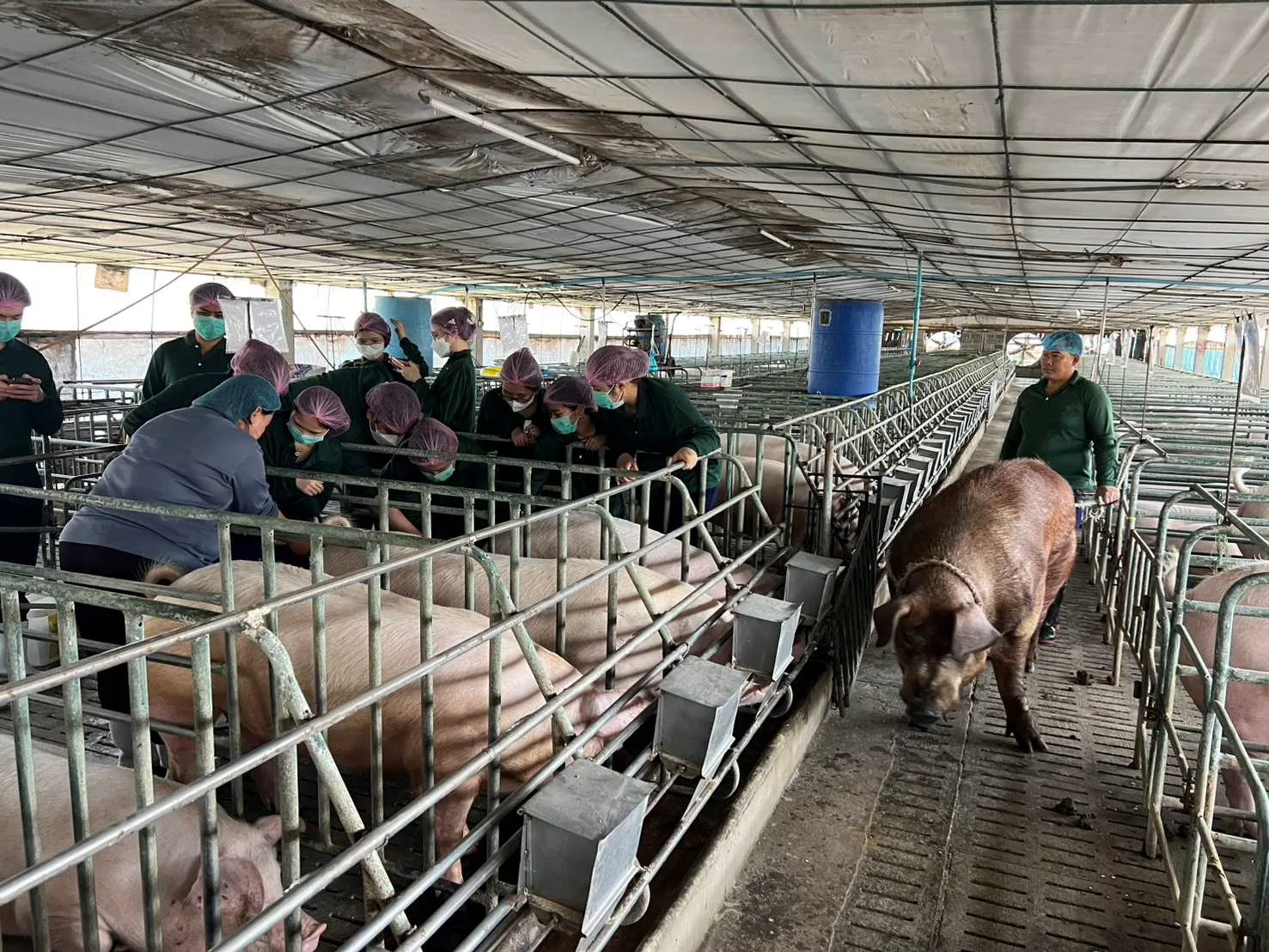
The innovation helps stimulate estrus in gilts, enabling them to develop into high-quality breeding sows while reducing the risk of disease transmission associated with direct contact with live boars.




Preparing young female pigs for breeding is a critical step in producing high-quality breeding sows. Yet many gilts are instead sent into the meat production system before they have the opportunity to become breeding animals.
How can we help young female pigs reach reproductive maturity more efficiently and safely? This question has driven researchers in Australia, the US, and Europe for the past two decades.
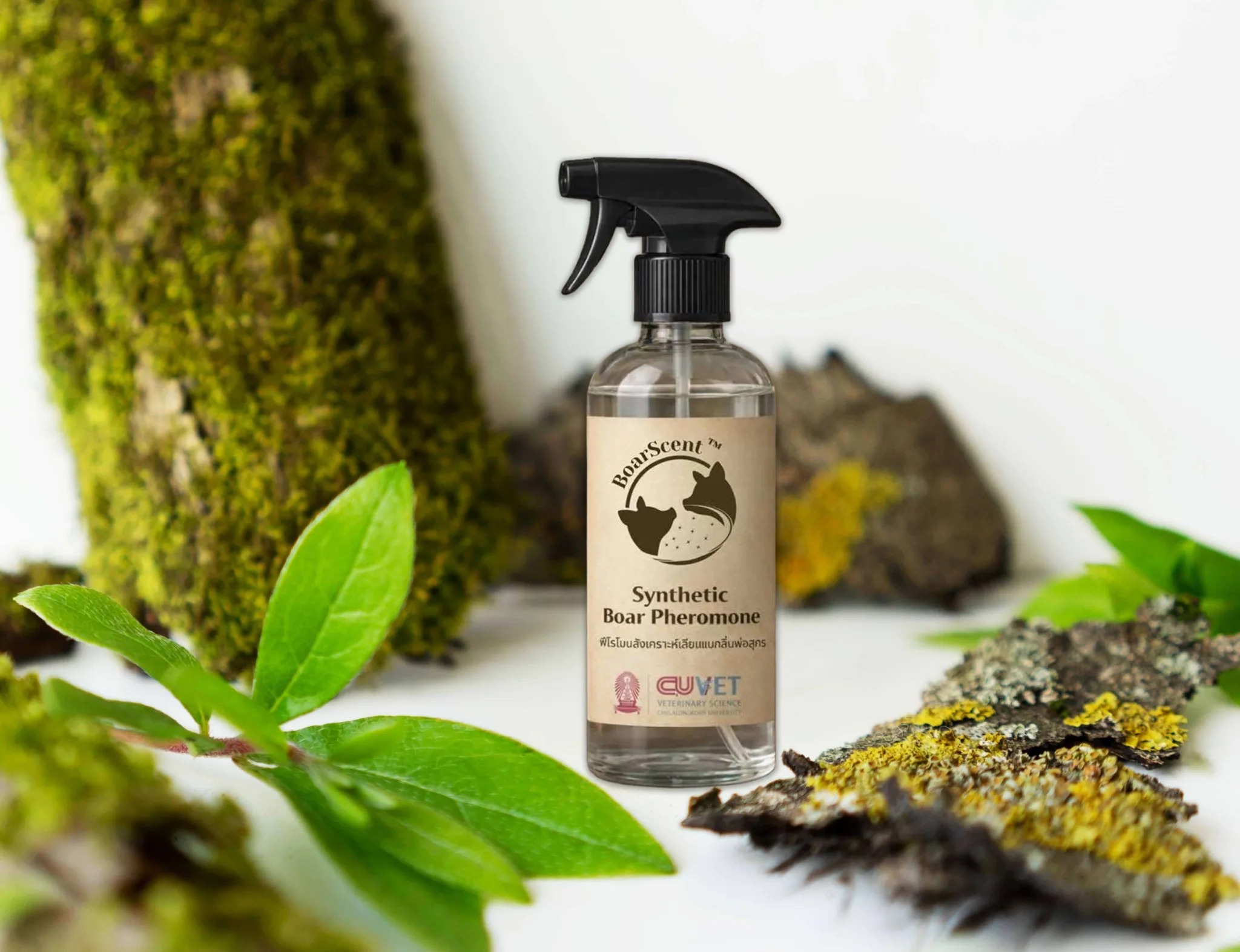
Now, a research team from Chulalongkorn University’s Faculty of Veterinary Science has found an answer: synthetic boar scent mimicking natural pheromones.
The innovation helps stimulate estrus in gilts, enabling them to develop into high-quality breeding sows while reducing the risk of disease transmission associated with direct contact with live boars.


The synthetic boar scent builds on Chulalongkorn University’s earlier research into scent and olfactory communication. That work included the Rapid Sniffer Vehicle (Rod Dom Wai) project, a collaboration between the Faculty of Veterinary Science, the Faculty of Science, and the Faculty of Engineering to investigate scent-based detection of COVID-19 patients and develop scent-detection dog training during the COVID-19 pandemic.
An innovation born from a pig breeding challenge
Prof Padet Tummaruk of Chulalongkorn University’s Department of Obstetrics, Gynaecology and Reproduction and leader of the synthetic boar pheromone research team, said the innovation was developed to address a longstanding challenge in pig breeding.
Gilts are typically stimulated to enter estrus between 160 and 200 days of age. Those that fail to show signs of estrus during this period are usually removed from the breeding herd and diverted to meat production—even though they have never become pregnant. For farmers, this means significant economic losses, as well as wasted time and farm resources.
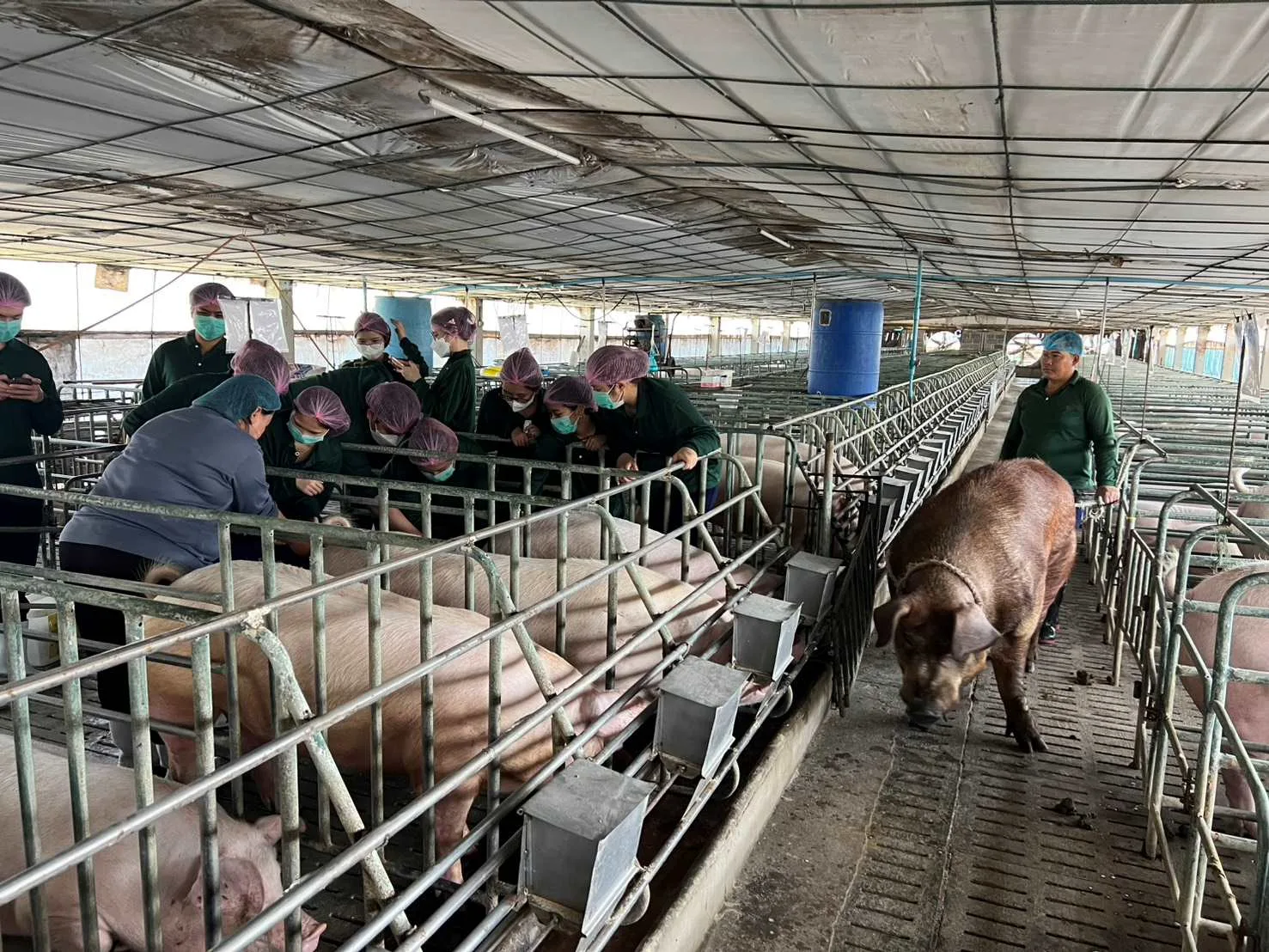
Today, the standard method used worldwide to naturally stimulate a gilt’s reproductive system is known as boar contact—exposing young female pigs to a mature boar.
Prof Padet explains, “Boar contact involves much more than simply allowing a gilt to see a mature boar. It also includes stimulation through other senses, such as hearing the boar’s vocalizations, detecting its scent, and direct physical contact, including nose-to-nose interaction between the animals.”
However, the boar contact method has important limitations in terms of both safety and farm management.
“Introducing a mature boar to stimulate gilts is not a simple task. Adult boars are large, powerful animals and can sometimes be aggressive. Handlers must be trained to control them safely and use protective equipment, such as ropes, metal panels, crates, or barriers, to reduce the risk of injury during handling,” Prof Padet explained.
The method also carries a risk of disease transmission, particularly African swine fever (ASF). Because there is currently no vaccine or treatment for the disease, an infected boar used to stimulate gilts could spread the virus throughout an entire farm.

Prof Padet Tummaruk (left) and Dr Isaya Thaveesangsakulthai.
Why does the boar scent matter?
Prof Padet said scent is one of the most important sensory cues through which animals detect chemical signals, or pheromones, that play a key role in stimulating sexual behavior in females.
That led the researchers to ask a simple question: What exactly do gilts smell when they are exposed to a mature boar?
Joining the search for the answer was Dr Isaya Thaveesangsakulthai, an expert in chemical communication and a postdoctoral researcher in Chulalongkorn University’s Department of Obstetrics, Gynaecology and Reproduction.
Dr Isaya also observed that not all gilts respond to a boar’s scent in the same way. Citing research from Canada, she explained that some gilts showed little or no response to one boar but responded when exposed to another.
The difference may lie in variations in their olfactory receptors and in how scent signals are processed in the brain, even when the animals are exposed to the same odor compounds.
Synthetic boar scent
Prof Padet explained that although pigs do not have sweat glands, mature boars still release chemical compounds through other bodily secretions—particularly saliva—which may contain pheromones involved in sexual communication.
To identify those chemical signals, the research team collected scent samples from five mature boars that had been used to stimulate gilts under actual farm conditions. Samples included saliva, urine, preputial secretions, and scent collected from the genital area. They were then analyzed in the laboratory using gas chromatography (GC) to separate and identify their volatile organic compounds (VOCs).
“The secretions collected from different parts of the boars shared approximately 80% of their chemical composition,” said Dr Isaya.
“What surprised us most was that the dominant scent profile was not unpleasant, as many people might expect, but a woody-green aroma.”
A woody-green scent combines notes reminiscent of natural wood, fresh leaves, and cut grass, creating an aroma often perceived as warm, clean, and refreshing.
Based on their analysis of scent samples from mature boars, the researchers identified 23 key odor compounds and used them to formulate the synthetic boar scent mimicking natural pheromones. The formulation was then evaluated in a comparative study involving three groups of gilts.
The results showed that exposure to a live boar induced estrus behavior in approximately 75% of the gilts. The synthetic scent achieved a response rate of about 50%, while the control group which received no stimulation, exhibited only 18% estrus behavior.
“Although exposure to a live boar remains more effective, the synthetic scent offers important advantages in terms of safety and ease of use,” Prof Padet said.
“It also reduces the risks associated with handling large animals and provides a safer alternative during disease outbreaks.”
A synthetic boar scent that closely replicates nature
Dr Isaya explained that the synthetic boar scent was formulated to replicate the mature boar’s unique odor profile as closely as possible, allowing it to serve as an alternative to using live boars for estrus stimulation.
“We carefully adjusted the scent intensity to match the pig’s olfactory system so that it would produce an effective behavioral response,” she said.
Safety is another key advantage of the innovation. According to Dr Isaya, the research team selected plant-based ingredients that are non-irritating, safe for people to inhale, and suitable for everyday use. The synthetic scent was also designed as a practical product that can be easily used under real farm conditions.
“To use the synthetic boar scent, farmers simply spray it onto a scent pad attached to a rod, then presented it for the gilt to sniff,” Dr Isaya explained.
“The system is simple, convenient, safe, and helps overcome many of the practical challenges of farm management. It is suitable for both small-scale farms and large commercial operations.”
Although the synthetic boar scent is still at the prototype stage, several large pig farms have already requested to test the product. Many other farms have also contacted the research team to express interest in testing it.
Bringing the innovation to Thai farmers
The research was published in a Tier 1 international scientific journal earlier this year, highlighting the potential of Thai research to develop innovations that address real-world challenges in the livestock industry.
Prof Padet said, “I want this research to be put to practical use. Ideally, it should be developed into a product manufactured in Thailand. Most pig farmers operate on narrow profit margins, so our goal is not to create another expense for them, but to reduce costs and make their work easier.”
Dr Isaya added that the research team has already filed a petty patent application to protect the innovation. They are currently working with manufacturers to produce a prototype and preparing to seek certification from Thailand’s Department of Livestock Development before introducing the product for commercial use.
Looking ahead, the team plans to investigate the scent profiles of gilts to better understand the differences between those that have reached puberty and those that have not. The findings could lead to the development of scent-based diagnostic tools for use on pig farms in the future.
“We want to develop a product made by Thai researchers, manufactured in Thailand, and affordable for Thai farmers, so they can truly benefit from this innovation without relying on imported products,” Prof Padet concluded.



Subscribe now to the technical pig magazine
AUTHORS

Bifet Gracia Farm & Nedap – Automated feeding in swine nurseries

The importance of Water on pig farms
Fernando Laguna Arán
Microbiota & Intestinal Barrier Integrity – Keys to Piglet Health
Alberto Morillo Alujas
Impact of Reducing Antibiotic use, the Dutch experience
Ron Bergevoet
The keys to successful Lactation in hyperprolific sows
Mercedes Sebastián Lafuente
Addressing the challenge of Management in Transition
Víctor Fernández Segundo
Dealing with the rise of Swine Dysentery
Roberto M. C. Guedes
Actinobacillus pleuropneumoniae – What are we dealing with?
Marcelo Gottschalk
The new era of Animal Welfare in Pig Production – Are we ready?
Antonio Velarde
Gut health in piglets – What can we do to measure and improve it?
Alberto Morillo Alujas
Interview with Cristina Massot – Animal Health in Europe after April 2021
Cristina Massot
Differential diagnosis of respiratory processes in pigs
Desirée Martín Jurado Gema Chacón Pérez


To provide the best experiences, we use technologies like cookies...