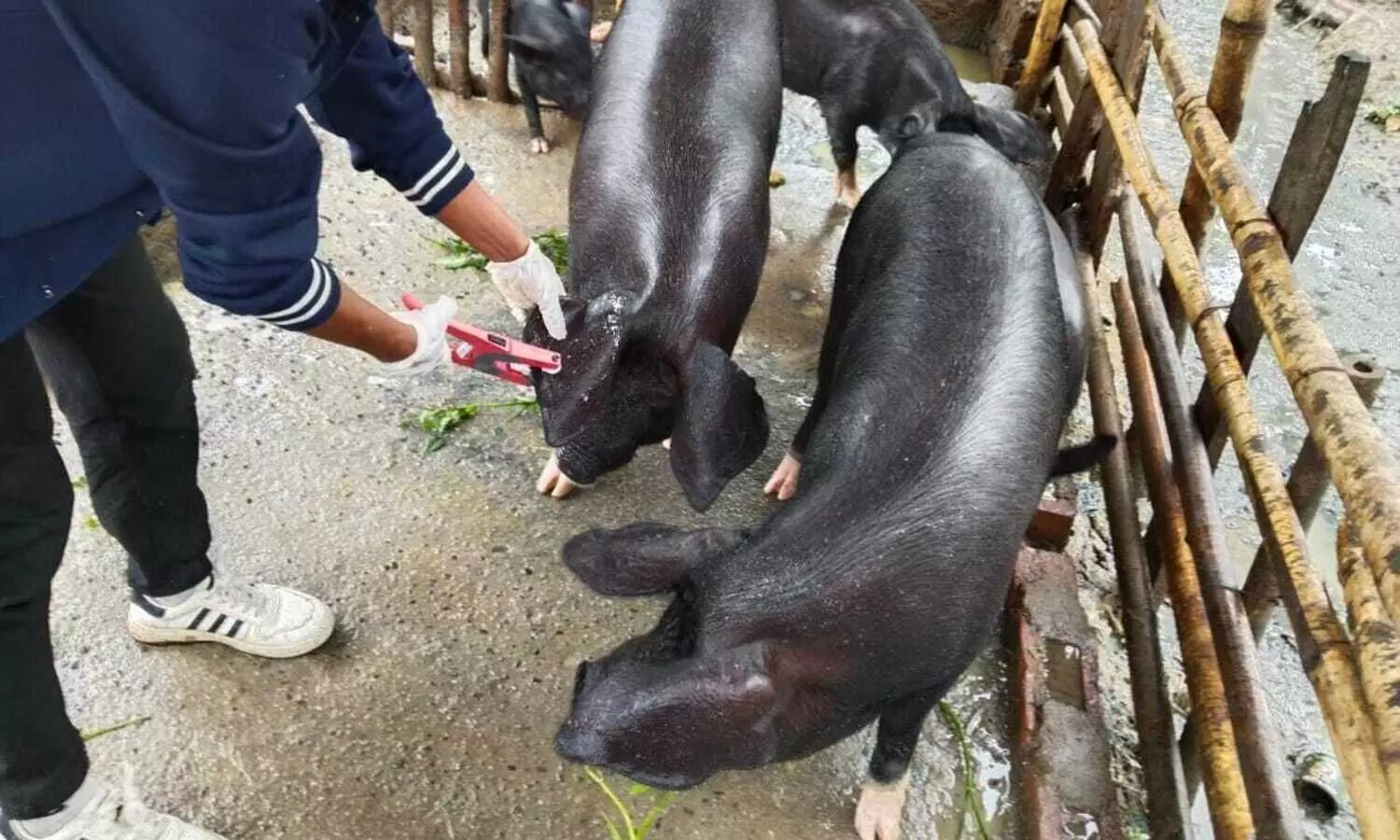
ICAR–NIHSAD’s MA-104 live attenuated vaccine represents a significant advance in India’s efforts to strengthen preparedness against ASF.





India has unveiled its first indigenous MA-104 cell-based live attenuated African swine fever (ASF) vaccine, representing a significant advance in India’s efforts to strengthen preparedness against one of the world’s most devastating swine diseases.
The vaccine was introduced during the 98th Foundation Day of the Indian Council of Agricultural Research (ICAR) at the NASC Complex in New Delhi, where several livestock health technologies developed by ICAR institutes were showcased.
Developed by the ICAR–National Institute of High Security Animal Diseases (NIHSAD), Bhopal, the vaccine candidate is derived from an Indian field isolate of ASF virus Genotype II through serial passage in MA-104 cell cultures, resulting in a live attenuated strain with targeted gene deletions.


ASF outbreaks in India
ASF remains one of the most destructive diseases affecting domestic and wild pigs. With mortality rates that can reach 100%, the disease has caused severe economic losses across Asia, Europe and parts of Africa.
There is currently no approved treatment, making rapid diagnosis, strict biosecurity and effective vaccination the cornerstone of long-term disease control.
India has reported ASF outbreaks in several states since the disease was first detected in 2020, particularly in the North-Eastern region, resulting in significant losses to pig farmers.
These outbreaks have highlighted the need for indigenous technologies that can strengthen national preparedness and reduce dependence on imported veterinary solutions.
Translating research into applicable technology
The MA-104 vaccine reflects years of research by NIHSAD scientists and demonstrates India’s expanding capability in high-containment animal disease research.
Although the vaccine was officially unveiled, details regarding regulatory approval, field validation, licensing, commercial production and nationwide deployment are yet to be announced.
The announcement also aligns with the Government of India’s broader objective of promoting indigenous agricultural and livestock technologies under the Atmanirbhar Bharat initiative.
During the Foundation Day celebrations, Union Agriculture Minister Shivraj Singh Chouhan emphasized the importance of translating publicly funded research into technologies that directly benefit farmers through stronger public-private collaboration.
Investment in animal health research and disease preparedness
The unveiling of the MA-104 vaccine underscores India’s growing investment in animal health research and disease preparedness.
As regulatory evaluation and field validation progress, the livestock industry will closely watch its transition from laboratory innovation to a practical disease-control tool for pig producers.






Subscribe now to the technical pig magazine
AUTHORS

Bifet Gracia Farm & Nedap – Automated feeding in swine nurseries

The importance of Water on pig farms
Fernando Laguna Arán
Microbiota & Intestinal Barrier Integrity – Keys to Piglet Health
Alberto Morillo Alujas
Impact of Reducing Antibiotic use, the Dutch experience
Ron Bergevoet
The keys to successful Lactation in hyperprolific sows
Mercedes Sebastián Lafuente
Addressing the challenge of Management in Transition
Víctor Fernández Segundo
Dealing with the rise of Swine Dysentery
Roberto M. C. Guedes
Actinobacillus pleuropneumoniae – What are we dealing with?
Marcelo Gottschalk
The new era of Animal Welfare in Pig Production – Are we ready?
Antonio Velarde
Gut health in piglets – What can we do to measure and improve it?
Alberto Morillo Alujas
Interview with Cristina Massot – Animal Health in Europe after April 2021
Cristina Massot
Differential diagnosis of respiratory processes in pigs
Desirée Martín Jurado Gema Chacón Pérez


To provide the best experiences, we use technologies like cookies...