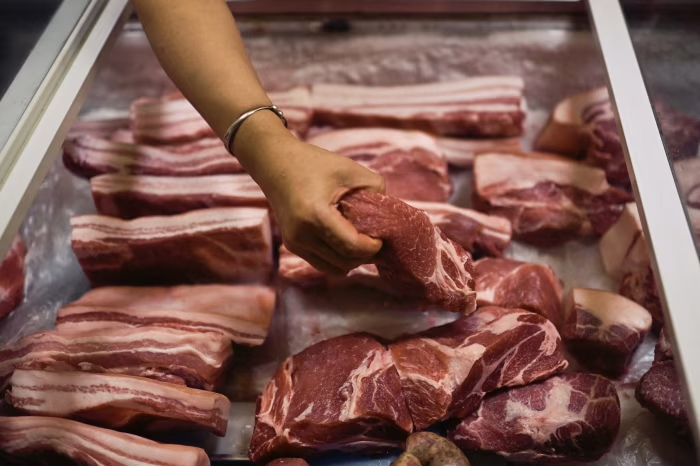
Duroc is one of the most popular terminal sire pig breeds worldwide due to its greater growth rate.





A study performed by Hui Wen from the Department of Animal Sciences at Purdue University and her team, was to investigate population structure and genetic diversity of Duroc subpopulations from Europe, North America, and Australia, and of other pig breeds.
Duroc is one of the most popular terminal sire pig breeds worldwide due to its greater growth rate, meat quality, feed efficiency, and carcass characteristics compared to other breeds.
Despite the breed’s popularity, its developmental history, genetic diversity, and genetic relationships with other pig breeds remain largely unknown.
Results

The studied pig populations were differentiated into five subgroups (European and North American Durocs, Australian Durocs, Asian-Pacific pig breeds, and two other breed groups [OBP1 and OBP2]), consistent with their geographical origins, as revealed by population structure analyses.
The estimated effective population size (Ne) of Duroc subpopulations ranged from 17 to 47, while the Ne for the combined Duroc subpopulations was 172.
A total of 140,713 runs of homozygosity (ROHs) were identified across all individuals, with 98,039 ROHs in Durocs and 42,674 in other pig breeds. Durocs had a greater number and proportion of longer ROHs (> 8 Mb) compared to other pig breeds.
The ROH-based inbreeding (FROH) values were significantly greater in Durocs than in most of the other breeds, indicating the need for better management of genetic diversity in the breed.
The researchers observed strong correlations (> 0.65) between different inbreeding metrics in all the studied pig populations. A total of 43, 18, 27, 37, and 20 candidate genes were identified in the ROH islands for European and North American Durocs, Australian Durocs, Asian-Pacific pigs, OBP1, and OBP2 pigs, respectively.
The significant KEGG pathways were mainly related to growth, metabolism, immune system, cellular processes, and signal transduction.
Conclusions


Subscribe now to the technical pig magazine
AUTHORS

Bifet Gracia Farm & Nedap – Automated feeding in swine nurseries

The importance of Water on pig farms
Fernando Laguna Arán
Microbiota & Intestinal Barrier Integrity – Keys to Piglet Health
Alberto Morillo Alujas
Impact of Reducing Antibiotic use, the Dutch experience
Ron Bergevoet
The keys to successful Lactation in hyperprolific sows
Mercedes Sebastián Lafuente
Addressing the challenge of Management in Transition
Víctor Fernández Segundo
Dealing with the rise of Swine Dysentery
Roberto M. C. Guedes
Actinobacillus pleuropneumoniae – What are we dealing with?
Marcelo Gottschalk
The new era of Animal Welfare in Pig Production – Are we ready?
Antonio Velarde
Gut health in piglets – What can we do to measure and improve it?
Alberto Morillo Alujas
Interview with Cristina Massot – Animal Health in Europe after April 2021
Cristina Massot
Differential diagnosis of respiratory processes in pigs
Desirée Martín Jurado Gema Chacón Pérez


To provide the best experiences, we use technologies like cookies...