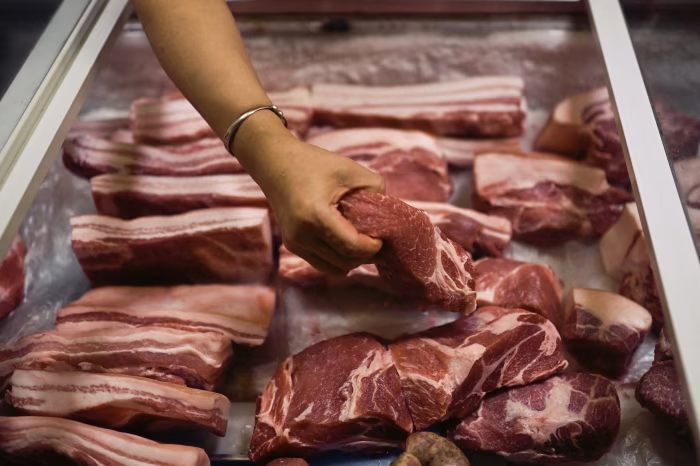
A massive influx of cheap imported meat into the Vietnamese market and high feed costs are pushing domestic livestock farmers to the brink.





A massive wave of low-priced imported meat is flooding the Vietnamese market, driving domestic live hog and poultry prices down to their lowest levels this year.
Paired with high feed costs and subdued consumer spending, local livestock farmers and enterprises now face an intense double whammy.
According to preliminary customs statistics, Vietnam imported 494,300 tons of meat and meat products worth approximately USD 1.46 billion in the first six months of 2026. This marks a 9.6% increase in volume and a 36.4% jump in value compared to the same period in 2025.
In Q2 2026 alone, meat imports reached 271,100 tons (USD 810.1 million), up 21.5% in volume from Q1 2026 and up 14.4% compared to Q2 2025. Key imported categories include poultry products, edible offal (pork, beef, and poultry), frozen pork, and frozen beef.


Top pork suppliers in Q2 were Spain (13,300 tons), Brazil (11,200 tons, which is up up 26.5% from Q1); and Russia (10,700 tons). Despite higher freight rates, average import prices stayed low at USD 2.95/kg.
These cheap imports undercut domestic products, intensifying competitive pressure on local farmers and enterprises already struggling with high feed costs.
Weak consumer demand, rising production, and cheap imports combined to push farmgate prices to their lowest levels this year.
Live hog prices hit lowest point of the year
While live hog prices hovered between USD 2.36-2.55 per kg in July, new data from the Ministry of Agriculture and Environment indicate that prices have now crashed to USD 2.21-2.36/kg nationwide:
Livestock enterprises confirm these are the lowest hog prices since early 2026, leaving farmers with shrinking margins.
Poultry farmers selling below production cost
The poultry sector faces a similar crisis. A rapid expansion of poultry flocks late last year led to widespread oversupply, particularly in industrial white-feather broilers.
Vietnam’s livestock paradox is clear: strong domestic production but heavy reliance on imports, while exports remain minimal.
In Q2 2026, exports totaled just 4600 tons of meat (USD 29.4 million), down 25.4% in volume year-on-year. Six-month exports reached only 9300 tons (USD 62.73 million).
Industry leaders warn that high feed costs and depressed selling prices leave farmers vulnerable to losses unless productivity improves significantly.
To survive without relying on trade protectionism, domestic producers and enterprises must focus on long-term competitiveness. This means they must lower costs through better breeding efficiency, feed conversion, and biosecurity. Aligning farmgate costs with international benchmarks is critical.
Shifting toward value‑added exports offers another path. Agreements with South Korea to open markets for processed poultry highlight opportunities for higher‑margin growth.



Subscribe now to the technical pig magazine
AUTHORS

Bifet Gracia Farm & Nedap – Automated feeding in swine nurseries

The importance of Water on pig farms
Fernando Laguna Arán
Microbiota & Intestinal Barrier Integrity – Keys to Piglet Health
Alberto Morillo Alujas
Impact of Reducing Antibiotic use, the Dutch experience
Ron Bergevoet
The keys to successful Lactation in hyperprolific sows
Mercedes Sebastián Lafuente
Addressing the challenge of Management in Transition
Víctor Fernández Segundo
Dealing with the rise of Swine Dysentery
Roberto M. C. Guedes
Actinobacillus pleuropneumoniae – What are we dealing with?
Marcelo Gottschalk
The new era of Animal Welfare in Pig Production – Are we ready?
Antonio Velarde
Gut health in piglets – What can we do to measure and improve it?
Alberto Morillo Alujas
Interview with Cristina Massot – Animal Health in Europe after April 2021
Cristina Massot
Differential diagnosis of respiratory processes in pigs
Desirée Martín Jurado Gema Chacón Pérez


To provide the best experiences, we use technologies like cookies...