EU producers welcomed China’s lower pork tariffs, though the European Commission pledged to challenge Beijing’s trade defense measures.





China finalized its ruling on EU pork tariffs, lowering tariffs compared to earlier provisional rates. The Ministry of Commerce confirmed tariffs will now range from 4.9–19.8% for five years. This replaces preliminary duties that reached 62.4%, easing pressure on exporters.
The decision follows an 18‑month anti‑dumping investigation, launched after the EU imposed tariffs on Chinese electric vehicles. Importers will also receive refunds for the difference between the higher provisional rates and the new levels.
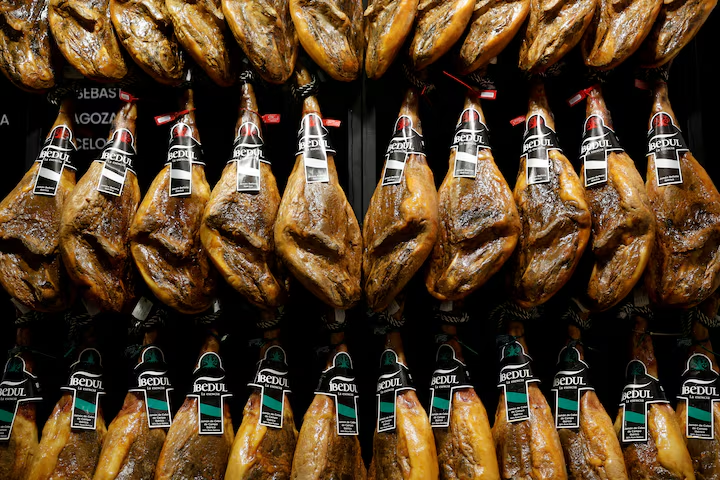
Spain, Denmark, and the Netherlands expressed relief at the lower tariffs. Spain, the EU’s largest pork supplier to China, had lobbied for reduced rates. Officials described the new duties as manageable compared to earlier provisional levels.
China remains a vital market for European pork, especially offal products such as pig ears and feet. These items have limited demand elsewhere, making access to China essential. In 2024, over half of China’s USD 4.8 billion pork imports came from the EU, with Spain accounting for 17.6% of EU exports.


The European Commission criticized the investigation, calling it “based on questionable allegations and insufficient evidence.” It pledged to defend EU farmers and exporters while reviewing compliance with World Trade Organization rules.
This ruling highlights wider trade tensions. China has already imposed duties on EU brandy and is investigating dairy exports. Talks on electric vehicle tariffs continue, with recent visits by European leaders underscoring the political stakes.
European producers see the ruling as a partial reprieve, securing stability for the next five years. Spanish Agriculture Minister Luis Planas welcomed the decision but stressed that negotiations could still alter the outcome. He noted that “everything is reversible” through dialogue.
China’s move reflects its balancing act between protecting domestic industries and ensuring access to essential imports. For European exporters, the reduced tariffs provide breathing space, though trade relations remain fragile.


Subscribe now to the technical pig magazine
AUTHORS

Bifet Gracia Farm & Nedap – Automated feeding in swine nurseries

The importance of Water on pig farms
Fernando Laguna Arán
Microbiota & Intestinal Barrier Integrity – Keys to Piglet Health
Alberto Morillo Alujas
Impact of Reducing Antibiotic use, the Dutch experience
Ron Bergevoet
The keys to successful Lactation in hyperprolific sows
Mercedes Sebastián Lafuente
Addressing the challenge of Management in Transition
Víctor Fernández Segundo
Dealing with the rise of Swine Dysentery
Roberto M. C. Guedes
Actinobacillus pleuropneumoniae – What are we dealing with?
Marcelo Gottschalk
The new era of Animal Welfare in Pig Production – Are we ready?
Antonio Velarde
Gut health in piglets – What can we do to measure and improve it?
Alberto Morillo Alujas
Interview with Cristina Massot – Animal Health in Europe after April 2021
Cristina Massot
Differential diagnosis of respiratory processes in pigs
Desirée Martín Jurado Gema Chacón Pérez