Swine raisers push USD 3.39/kg floor price as farmgate rates fall to USD 1.94–2.58, but agri department says it lacks authority.





Philippine pig producers are pressing for a USD 3.39/kg floor price as live pig prices sink to unsustainable levels. The Department of Agriculture (DA) has acknowledged the proposal but clarified that it cannot legally impose mandatory floors. The debate has exposed the limits of government intervention in a sector already strained by disease risks and rising imports.
Farmgate prices have fallen to between USD 1.94 and USD 2.58/kg, prompting warnings from swine raisers that many small producers may be forced out of business. They argue that without a floor price, supply could shrink, eventually destabilizing the market. The USD 3.39 figure was presented during the National Swine Summit as a safeguard against further losses.
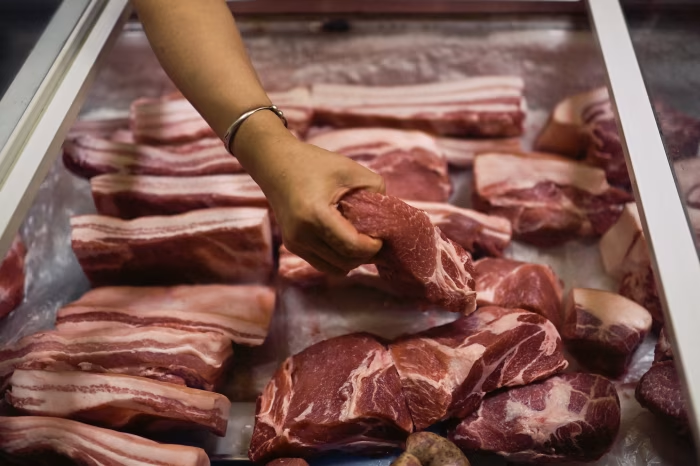
The gap between farmgate and retail prices has widened sharply. While pigs sell at less than USD 2.60/kg, retail pork belly remains near USD 6.13. Producers say this disparity highlights inefficiencies in the supply chain and raises questions about who benefits from the margins. Consumers continue to pay high retail prices despite falling farmgate rates, fueling frustration among swine raisers.
Imports have added another layer of pressure. Volumes rose more than 10% in the first seven months of 2026, intensifying competition for local producers.


“We cannot impose a mandatory floor price, but we can use tariffs to protect local producers,” explained Agriculture Secretary Francisco Tiu Laurel Jr.

Agriculture Secretary Francisco Tiu Laurel Jr
(2nd from left; Photo credit: Philippine Department of Agriculture)
He added that restoring higher tariffs and safeguard duties would provide a legal path for government action. “Our priority is to ensure fair competition and prevent imported pork from overwhelming the domestic market.”
The DA has also pledged to strengthen monitoring of imported pork in wet markets, aiming to ensure compliance with safety standards and trade rules. Officials believe that tariff adjustments, combined with stricter inspections, could help stabilize the sector without violating existing laws.
Lingering fears of African swine fever continue to weigh on consumer confidence and production planning. Industry leaders argue that without stronger biosecurity, price measures alone will not stabilize the sector. The DA has emphasized disease prevention as a critical component of its strategy, noting that outbreaks could undermine any gains from tariff adjustments.
With the Christmas season approaching, demand is expected to rise. Swine raisers hope that stronger demand will help offset falling farmgate prices, but many remain cautious. Whether tariff adjustments can balance supply and protect producers will determine if the industry can recover. The debate illustrates the limits of price controls and the need for comprehensive policy solutions that combine trade measures, disease management, and supply chain reforms.




Subscribe now to the technical pig magazine
AUTHORS

Bifet Gracia Farm & Nedap – Automated feeding in swine nurseries

The importance of Water on pig farms
Fernando Laguna Arán
Microbiota & Intestinal Barrier Integrity – Keys to Piglet Health
Alberto Morillo Alujas
Impact of Reducing Antibiotic use, the Dutch experience
Ron Bergevoet
The keys to successful Lactation in hyperprolific sows
Mercedes Sebastián Lafuente
Addressing the challenge of Management in Transition
Víctor Fernández Segundo
Dealing with the rise of Swine Dysentery
Roberto M. C. Guedes
Actinobacillus pleuropneumoniae – What are we dealing with?
Marcelo Gottschalk
The new era of Animal Welfare in Pig Production – Are we ready?
Antonio Velarde
Gut health in piglets – What can we do to measure and improve it?
Alberto Morillo Alujas
Interview with Cristina Massot – Animal Health in Europe after April 2021
Cristina Massot
Differential diagnosis of respiratory processes in pigs
Desirée Martín Jurado Gema Chacón Pérez


To provide the best experiences, we use technologies like cookies...