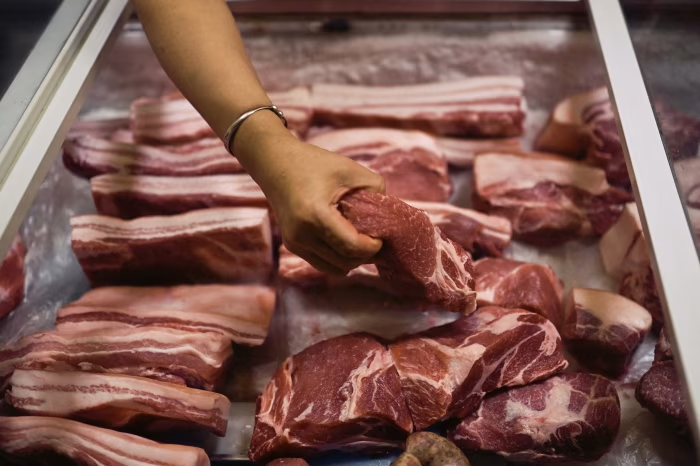
The government expanded the minimum access volume for pork for 2026, citing ASF losses, but industry groups warned of risks to local producers.





Philippine President Ferdinand Marcos Jr has ordered a sharp increase in the minimum access volume (MAV) for pork imports in 2026. The move aims to stabilize domestic supply and ease consumer prices, which remain pressured by African swine fever (ASF) losses.
Executive Order No. 16, s. 2026 raised the MAV allocation for pork from 54,210 tons to 204,210 tons. The increase adds 150,000 MT annually for two years. Officials adjusted the quota to address shortfalls in local production and ensure sufficient stocks for the remainder of the year.
The expanded quota includes 30,000 MT for processors and 120,000 MT for Food Terminal Inc and the Kadiwa ng Pangulo Program, which links farmers and fisherfolk directly to consumers. Authorities said these allocations would help stabilize prices in wet markets and supermarkets, while ensuring processors have access to raw materials.
The DA emphasized that import permits would be closely monitored to prevent abuse. Shipments must meet sanitary standards, and distribution will be coordinated with government programs to reach consumers directly.


Several legislators expressed concern that the expanded quota could harm local swine raisers. They warned that higher imports may depress farmgate prices and weaken rural livelihoods. Other lawmakers urged the government to balance consumer needs with producer protection, noting that past import surges failed to lower retail prices.
Industry groups echoed these worries. The Samahang Industriya ng Agrikultura (Sinag) argued that increasing pork imports would deepen dependence on foreign supply. They stressed that local farmers continue to struggle with rising feed costs and limited government support.
Rolando Tambago, Vice-Chairman of the Pork Producers Federation of the Philippines, criticized the decision as disconnected from industry realities. He stressed that the swine sector is already recovering from ASF and that supply is sufficient.
“Raising the MAV with lower tariffs is unnecessary and would only set back local production,” Mr Tambago told porciNews Asia.
He added that the government’s reliance on imports has been repeated annually since 2020 but has consistently failed to lower retail prices. He argued that the policy benefits traders and importers while undermining local producers. Despite low farmgate prices and cheaper imports, consumers still face high retail costs—evidence, he said, of structural weaknesses in the supply chains.
Mr Tambago further noted that the decision bypassed proper consultation with stakeholders and did not follow the established process through the MAV Council and Management Committee.
ASF outbreaks remain a major challenge for the hog industry. The DA reported that several provinces still face herd losses, reducing overall output. Officials said the MAV expansion was a temporary measure to offset these disruptions.
The current administration emphasized that the government would continue supporting local producers through disease control programs and logistical assistance. Authorities added that the government’s priority is balancing consumer affordability with producer viability.
Economic managers argued that the quota hike was necessary to prevent sharp price increases in the coming months. They noted that pork remains a staple protein for Filipino households, making supply stability a priority.
Farmer groups countered that retail prices are shaped more by supply chain inefficiencies than by import volumes. They urged the government to strengthen domestic production and improve value chain efficiency instead of relying on foreign shipments.
The debate underscores the continuing tension between consumer affordability and industry resilience. As ASF persists, policymakers face the challenge of meeting immediate supply needs while ensuring long-term recovery for local producers.





Subscribe now to the technical pig magazine
AUTHORS

Bifet Gracia Farm & Nedap – Automated feeding in swine nurseries

The importance of Water on pig farms
Fernando Laguna Arán
Microbiota & Intestinal Barrier Integrity – Keys to Piglet Health
Alberto Morillo Alujas
Impact of Reducing Antibiotic use, the Dutch experience
Ron Bergevoet
The keys to successful Lactation in hyperprolific sows
Mercedes Sebastián Lafuente
Addressing the challenge of Management in Transition
Víctor Fernández Segundo
Dealing with the rise of Swine Dysentery
Roberto M. C. Guedes
Actinobacillus pleuropneumoniae – What are we dealing with?
Marcelo Gottschalk
The new era of Animal Welfare in Pig Production – Are we ready?
Antonio Velarde
Gut health in piglets – What can we do to measure and improve it?
Alberto Morillo Alujas
Interview with Cristina Massot – Animal Health in Europe after April 2021
Cristina Massot
Differential diagnosis of respiratory processes in pigs
Desirée Martín Jurado Gema Chacón Pérez