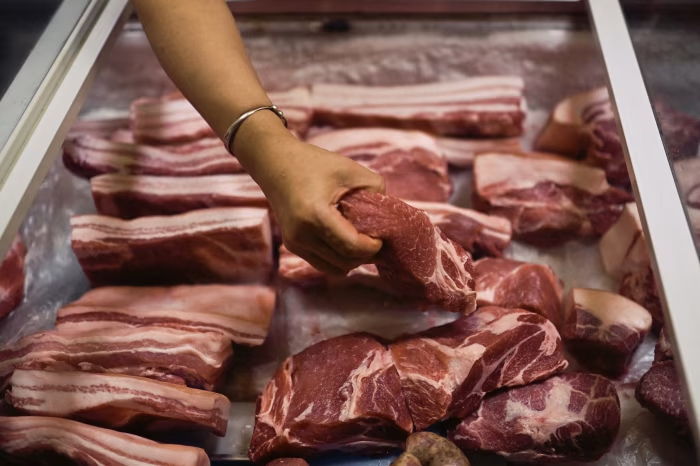
Philippine pork imports rose 62% in early 2026, strengthening Brazil’s swine industry despite weak domestic demand and falling local prices.





The Philippines has become the largest buyer of Brazilian pork, helping drive export growth despite weak domestic demand in Brazil. In April 2026, Philippine purchases accounted for more than a quarter of Brazil’s shipments, underscoring Southeast Asia’s rising role in global pork trade.
Brazil exported 138,300 tons of pork in April, according to Cepea (Centro de Estudos Avançados em Economia Aplicada, University of São Paulo) based on Secex data — the highest April volume ever recorded. The Philippines imported 34,262 tons, representing 25.19% of total shipments, firmly placing the country at the top of Brazil’s export destinations.
Japan followed with 16,605 tons of Brazilian pork, while China and Chile imported 11,829 tons and 11,106 tons, respectively. Together, these four markets absorbed more than half of Brazil’s exports.
The Brazilian Association of Animal Protein (ABPA) reported a slightly higher figure of 140,000 tons, reflecting its broader industry tracking. Both sources confirm strong growth, though Cepea’s Secex-based data is considered the official benchmark.


Revenue from pork exports reached USD 324.1 million in April, with an average price of USD 2383/ton. Prices remained stable compared to earlier months, though differences between destinations were clear.
Japan paid USD 3318/ton for Brazilian pork, reflecting demand for premium cuts. By contrast, the Philippines and China averaged USD 2200–2300/ton, highlighting their role as volume-driven markets.
Frozen pork accounted for 83% of Brazil’s exports, exceeding 113,000 tons. Offals represented nearly 10%, pieces about 5%, and carcasses just 2%. This mix illustrates Brazil’s focus on processed shipments tailored to diverse international buyers.
From January to April, Brazil shipped 516,400 tons of pork, a 15.8% increase compared to the same period in 2025. Revenue rose 16.1%, totaling USD 1.23 billion.
Philippine purchases of Brazilian pork jumped from 95,900 tons in early 2025 to 155,500 tons in 2026, marking a 62% increase. Japan also expanded imports, while China and Hong Kong reduced volumes, reinforcing the importance of diversifying Brazil’s overseas markets.
Brazil’s swine industry continues to rely on exports amid weak domestic consumption and lower prices. Philippine demand, combined with Japan’s premium market, provides resilience.
According to Cepea, April 2026 marked the highest pork export volume ever recorded for the month, at 138,300 tons. Exports accounted for about 26% of national production, the fifth consecutive monthly record. Yet Cepea noted that domestic pork prices remained under pressure, showing that strong international demand has not fully offset weakness in Brazil’s local market.





Subscribe now to the technical pig magazine
AUTHORS

Bifet Gracia Farm & Nedap – Automated feeding in swine nurseries

The importance of Water on pig farms
Fernando Laguna Arán
Microbiota & Intestinal Barrier Integrity – Keys to Piglet Health
Alberto Morillo Alujas
Impact of Reducing Antibiotic use, the Dutch experience
Ron Bergevoet
The keys to successful Lactation in hyperprolific sows
Mercedes Sebastián Lafuente
Addressing the challenge of Management in Transition
Víctor Fernández Segundo
Dealing with the rise of Swine Dysentery
Roberto M. C. Guedes
Actinobacillus pleuropneumoniae – What are we dealing with?
Marcelo Gottschalk
The new era of Animal Welfare in Pig Production – Are we ready?
Antonio Velarde
Gut health in piglets – What can we do to measure and improve it?
Alberto Morillo Alujas
Interview with Cristina Massot – Animal Health in Europe after April 2021
Cristina Massot
Differential diagnosis of respiratory processes in pigs
Desirée Martín Jurado Gema Chacón Pérez


To provide the best experiences, we use technologies like cookies...