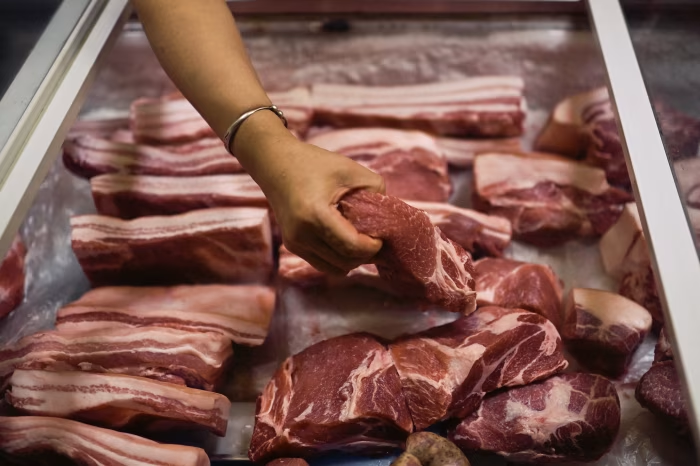
Hanoi has ordered operators to cease operations, switch models, or move slaughtering to qualified facilities.





Hanoi, Vietnam has closed all small-scale, informal slaughterhouses, moving slaughtering activities to 71 centralized facilities. The shift strengthens controls over animal origins and food safety for around 90,000 livestock and poultry processed daily.
For years, scattered slaughtering in residential areas have made hygiene and traceability difficult. difficult to control animal origins, veterinary hygiene and food safety.
According to the Hanoi Department of Agriculture and Environment, before Plan No. 283 was implemented in late 2025, the city had 701 slaughtering facilities, with 666 traditional slaughterhouses accounting for nearly 95% of the total.
Their operations not only posed environmental risks due to untreated waste, but also created gaps in veterinary control, traceability and disease prevention.


Authorities required operators to either end their activities, convert to other businesses, or move to qualified facilities. By early September 2026, all commune and ward authorities had issued directives and formed inspection teams. As a result, informal slaughterhouses were eliminated, with no new sites emerging.
Eligible operators were encouraged to move their activities to 71 centralized slaughtering facilities. Animals must have valid quarantine documentation. Veterinary authorities inspect around 6500 pigs, 85,000 poultry and 300 cattle and buffaloes daily, and carcasses are stamped before they enter the market.
Alongside relocation, Hanoi intensified inspections along transport routes, at traditional markets, and in high-risk areas. Since mid-2025, Since mid-2025, three cases of pork contaminated with African swine fever were detected. Products were destroyed, and 10 individuals were prosecuted.
Two facilities violating hygiene rules were fined USD 1,800. At traditional markets, vendors are barred from slaughtering animals on-site. Meat without inspection stamps or clear origins is rejected.
To sustain centralized slaughtering operations, Hanoi approved a plan (Decision No. 4314) for 28 new large-scale slaughterhouses across 25 suburban communes. These facilities will follow industrial and semi-industrial standards, include wastewater treatment systems, suitable transport infrastructure, and accommodate small-scale operators nearby.
The agriculture sector will continue attracting investment while improving efficiency at existing facilities. The transition from more than 660 traditional slaughterhouses to a centralized system is expected to strengthen traceability, hygiene, and disease control, laying the foundation for a safer and more transparent meat supply chain.




Subscribe now to the technical pig magazine
AUTHORS

Bifet Gracia Farm & Nedap – Automated feeding in swine nurseries

The importance of Water on pig farms
Fernando Laguna Arán
Microbiota & Intestinal Barrier Integrity – Keys to Piglet Health
Alberto Morillo Alujas
Impact of Reducing Antibiotic use, the Dutch experience
Ron Bergevoet
The keys to successful Lactation in hyperprolific sows
Mercedes Sebastián Lafuente
Addressing the challenge of Management in Transition
Víctor Fernández Segundo
Dealing with the rise of Swine Dysentery
Roberto M. C. Guedes
Actinobacillus pleuropneumoniae – What are we dealing with?
Marcelo Gottschalk
The new era of Animal Welfare in Pig Production – Are we ready?
Antonio Velarde
Gut health in piglets – What can we do to measure and improve it?
Alberto Morillo Alujas
Interview with Cristina Massot – Animal Health in Europe after April 2021
Cristina Massot
Differential diagnosis of respiratory processes in pigs
Desirée Martín Jurado Gema Chacón Pérez


To provide the best experiences, we use technologies like cookies...