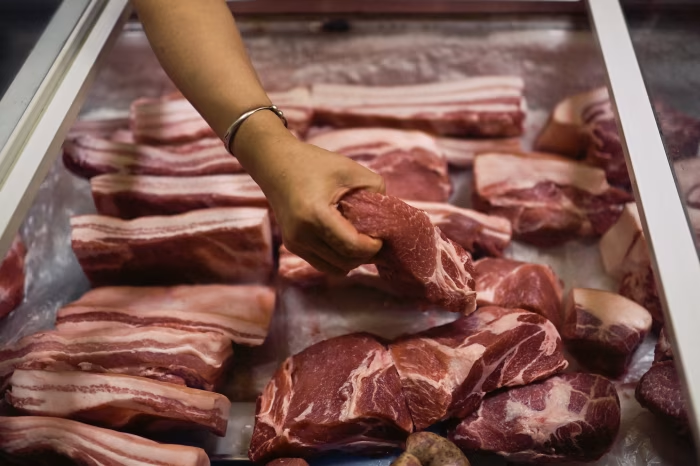
Authorities assure stable pork availability, citing imports and monitoring, even as domestic production declines and ASF risks persist.





Malaysia’s pork supply remains stable despite a sharp fall in pig farm numbers and Selangor’s farming ban, with imports cushioning domestic shortfalls. Agriculture Minister Mohamad Sabu assured that demand is being met, even as production declines and disease risks persist.
CodeBlue reported that Malaysia’s registered pig farms fell by 22% between 2024 and 2025, dropping from 435 to 338. Domestic pork production also declined, from 136,506 tons in 2024 to 115,283 tons in 2025.
Despite this, the Agriculture and Food Security Ministry projects national supply at 221,958 tons in 2025, comfortably above estimated demand of 213,928 tons. These figures suggest that while farm numbers and output have decreased, overall supply remains sufficient to meet consumption needs.
Mr Mohamad Sabu emphasized that imports from approved overseas establishments will cover any shortfall. He noted that supply monitoring remains crucial, given past disruptions from African Swine Fever (ASF).


The recent ban on pig farming in Selangor sparked questions about its impact on national supply. Authorities clarified that the ban does not threaten overall availability, as production in other states and imports remain sufficient.
Selangor’s decision reflects environmental and health concerns, but the ministry stressed that domestic demand among Malaysia’s non-Muslim population—36.5% of the total—is being met.
Industry observers note that while Selangor’s exit reduces local production, states such as Perak and Penang remain key contributors, ensuring continuity in supply.
The Department of Veterinary Services continues to track farm numbers, production capacity, and disease risks to ensure market stability. This monitoring is part of wider food security efforts under the 13th Malaysia Plan (13MP), which also targets higher self-sufficiency in vegetables such as chili, cabbage, and ginger.
By diversifying food production and strengthening monitoring, the government aims to balance supply stability with long-term resilience.




Subscribe now to the technical pig magazine
AUTHORS

Bifet Gracia Farm & Nedap – Automated feeding in swine nurseries

The importance of Water on pig farms
Fernando Laguna Arán
Microbiota & Intestinal Barrier Integrity – Keys to Piglet Health
Alberto Morillo Alujas
Impact of Reducing Antibiotic use, the Dutch experience
Ron Bergevoet
The keys to successful Lactation in hyperprolific sows
Mercedes Sebastián Lafuente
Addressing the challenge of Management in Transition
Víctor Fernández Segundo
Dealing with the rise of Swine Dysentery
Roberto M. C. Guedes
Actinobacillus pleuropneumoniae – What are we dealing with?
Marcelo Gottschalk
The new era of Animal Welfare in Pig Production – Are we ready?
Antonio Velarde
Gut health in piglets – What can we do to measure and improve it?
Alberto Morillo Alujas
Interview with Cristina Massot – Animal Health in Europe after April 2021
Cristina Massot
Differential diagnosis of respiratory processes in pigs
Desirée Martín Jurado Gema Chacón Pérez


To provide the best experiences, we use technologies like cookies...